While a modern-day look at the 1996 AL race showed major differences, today’s voters likely wouldn’t have too many qualms with how these races shook out.
The second part of the MLB award voting redux series has arrived, with the 1996 National League MVP race being the focus of this piece.
In the first full MLB season since the 1994-95 strike, the memorable power surge of the late ’90s began to take off in full force, with gaudy offensive numbers seemingly commonplace across the league.
While most of the criteria I’m looking to use in this series can be found in my initial post, I hope these rankings can serve as both an opinion piece and a modern interpretation of how some advanced metrics would have changed the results in some races.
This was certainly the case in the American League race in 1996, where real-life winner Juan González was outside of my top 10 when reassessing the race.
As for the senior circuit in 1996, the differences aren’t quite as stark, as I personally find it hard to have too much beef with Ken Caminiti’s win of the award for an outstanding season that helped drive the Padres to the playoffs.
Nonetheless, there remain plenty of changes to how I would shake out my ballot for this race at least, even if it’s not the most contentious at the top.
Here’s a look at the real-life voting breakdown for the 1996 NL MVP race, with a total of 24 players receiving votes on at least one writer’s ballot:

Unlike the incredibly close AL race, Caminiti was a unanimous winner in the National League, finishing well ahead of Dodgers catcher and runner-up Mike Piazza.
Below is a look at my personal rankings, listed alongside some stats, my reasoning and the change from their ranking in real-life.
10. Andrés Galarraga, Colorado Rockies, 1B (-4)
Season stats: 4.2 WAR, 119 R, 190 H, 39 2B, 47 HR, 150 RBI, 18 SB, 40 BB, 157 K, .304/.357/.601/.958, 127 OPS+
Dropping four spots from his sixth-place tie in the real-life voting, Galarraga’s relatively low WAR total is the result of a very hitter-friendly pre-humidor Coors Field, below-average defense and significantly lower production on the road.
Yet the counting stats are truly impossible to ignore, with the Big Cat still making the cut on virtue of leading all of MLB in RBI with 150, leading the NL in home runs en route to 89 extra-base hits and a monstrous second half which saw him post a 1.039 OPS over the course of 76 games.
The MVP award is also explicitly an award revolving around value to a team, and it’s hard to dispute Galarraga’s value to the stacked 1996 Rockies, even with the drastic home/away splits that include a .748 OPS away from Coors Field.
In addition to an excellent second half and a towering 1.123 OPS in Rockies wins, Galarraga was also perhaps the game’s most formidable clutch hitter in 1996, proving his lofty RBI total is not worth outright dismissing.
Galarraga hit an incredible .413/.449/.810/1.259 with runners in scoring position in 1996, with a 1.109 OPS and .391 batting average with two outs and runners in scoring position. He also performed best in high leverage situations, compiling a 1.039 OPS in such at-bats, according to Baseball Reference.
Though there are plenty of drawbacks regarding Galarraga’s 1996 season, there’s still plenty beneath the surface to support the bulky counting stats.
9. Kevin Brown, Florida Marlins, SP (+13)
Season stats: 7.9 WAR, 17-11, 1.89 ERA, 5 CG, 3 CGSHO, 233 IP, 33 BB, 159 K, 215 ERA+, 0.944 WHIP
Although I’m typically not a proponent of ranking pitchers high on MVP ballots, I don’t think it’s a hard and fast rule, with 1996 Kevin Brown emerging as a great reason why.
While the Marlins were still one year away from shocking the world by winning the Fall Classic in 1997, Brown offered a preview of the elite pitching the Fish needed and utilized a year later to win it all.
In an era marked by high batting averages and plentiful home runs, Brown stymied offenses all season long, producing the best ERA and WHIP in all of baseball, managing a 1.89 ERA while his next closest competition, Hall of Famer Greg Maddux, had an ERA of nearly an entire run higher at 2.72.
In addition to recording outs at a remarkably efficient and effective rate, Brown was also extremely stingy when it came to giving his opponent a break via mistake – Brown surrendered just eight home runs the entire season, while walking only 33 batters.
His power prevention also paved the way for an MLB-best 0.3 home runs per nine innings, as opponents overall managed just a .550 OPS against Brown.
Though still bested by a handful of impressive position player seasons, Brown’s 1996 campaign was arguably the finest of any hurler across the big leagues, making the absence of a Cy Young Award from this season the more notable story. But I’ll get to that later.
8. Gary Sheffield, Florida Marlins, RF (-2)
Season stats: 5.9 WAR, 118 R, 163 H, 33 2B, 42 HR, 120 RBI, 16 SB, 142 BB, 66 K, .314/.465/.624/1.090, 189 OPS+
Despite the Marlins finishing just 80-82 and out of a playoff spot, Brown’s performance was arguably overshadowed even within South Florida thanks to a sensational offensive campaign from Gary Sheffield.
One of the sport’s most successful journeyman players of all-time, Sheffield was, by many metrics, the National League’s most feared hitter in 1996, combining elite power with an unmatched ability to get on base.
On top of 42 home runs and 33 doubles, Sheffield also drew 142 walks to just 66 strikeouts, not displaying even a hint of being prone to the swing-and-miss the way most power hitters are.
Once on the basepaths, Sheffield made the most of his time, scoring 118 times while also swiping 16 bags, adding additional danger to an NL-best .465 OBP.
While Sheffield’s incredible offensive performance makes his inclusion in the top 10 a no-brainer, Sheffield ranked higher in real life and would rank higher on this list, if not for some truly lackluster defense.
Despite posting a career-high 7.7 offensive WAR, his season total is dragged down to 5.9 due to a well below-average performance in right field, amounting to -2.3 defensive WAR, the second-worst defensive season in Sheffield’s career.
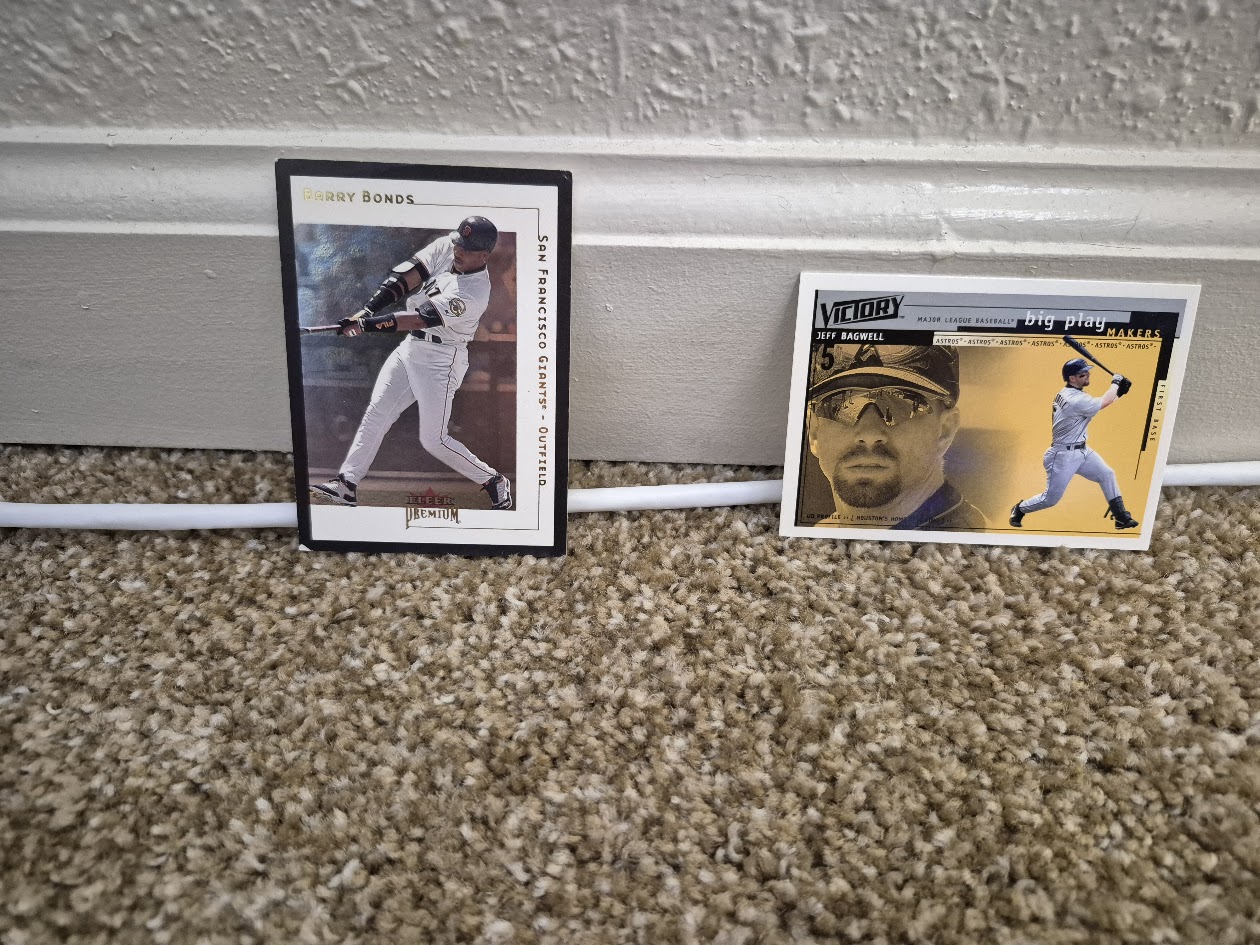
7. Jeff Bagwell, Houston Astros, 1B (+2)
Season stats: 7.5 WAR, 111 R, 179 H, 48 2B, 31 HR, 120 RBI, 21 SB, 135 BB, 114 K, .315/.451/.570/1.021, 178 OPS+
Finishing ninth in the real-life voting, Bagwell’s stellar 1996 season deserves a bit of reappraisal, even if it came alongside a -0.9 defensive WAR at first base.
Just two years removed from an amazing campaign that saw him win the NL MVP in the strike-shortened 1994 season, Bagwell once again held his position as one of the sport’s premier sluggers and most difficult outs.
While Bagwell combined his power, which contributed 81 extra-base hits, with a good amount of swing and miss, he still managed to walk more than he struck out all while doing some damage on the bases, swiping 21 bags.
Bagwell was also a monster with runners on base, posting a 1.079 OPS when at least one base was occupied, a number that remained above 1 with runners in scoring position and with two outs and runners in scoring position.
Though unquestionably stronger within the confines of the Astrodome, Bagwell was also a force to be reckoned with on the road, managing a .981 OPS with 23 doubles and 15 home runs.
Although Bagwell’s impressive 1996 campaign did not lead to playoff berth in Space City, the era of the Killer B’s would take hold in the following years, with Bagwell continuing to anchor a feared offense.
6. Bernard Gilkey, New York Mets, LF (+8)
Season stats: 8.1 WAR, 108 R, 181 H, 44 2B, 30 HR, 117 RBI, 17 SB, 73 BB, 125 K, .317/.393/.562/.955, 155 OPS+
In perhaps one of the most quietly impressive seasons of the 1990’s, Mets left fielder Bernard Gilkey put on a season-long show in every aspect of the game in 1996.
Though the contributions came for a Mets team that was never on the edges of playoff contention, finishing 71-91, Gilkey’s season was a significant force behind many of the victories, with the Mets weighed down by a pitching staff that finished with -0.9 WAR as a whole.
There’s plenty to love about Gilkey’s offensive contributions, providing elite offense from one of the game’s classic power positions in left field. With 77 extra-base hits paving the way to 321 total bases, Gilkey remained a contact and speed threat as well, managing a .317 average while still stealing 17 bases.
That offense shined through in moments where it was most needed as well, with Gilkey compiling a 1.172 OPS and .406 batting average with runners in scoring position, hitting nine of his 30 home runs in that scenario.
In addition to providing some of baseball’s best outfield offense, he also provided elite defense at a position where it is seldom prioritized, posting 1.6 defensive WAR.
While it’s hard to place Gilkey much higher due to the Mets’ performance and several other sensational seasons, his otherworldly 1996 campaign deserves to be remembered.
5. Chipper Jones, Atlanta Braves, 3B/SS (-1)
Season stats: 6.2 WAR, 114 R, 185 H, 32 2B, 5 3B, 30 HR, 110 RBI, 14 SB, 87 BB, 88 K, .309/.393/.530/.923, 137 OPS+
After quickly emerging as a centerpiece of the Braves offense in his first full year en route to a World Series title in 1995, Chipper Jones took a major step forward in 1996, one of many in a storied Hall of Fame career.
The eventual National League champion with remarkable depth across both the offense and the pitching staff, the Braves were greatly aided by even more of a breakout from Chipper Jones, with the switch-hitter especially coming into his own in the power department.
Most notably, Jones went from posting 48 extra-base hits in 1995 to an elite 67 in 1996, while also managing a 40-point improvement to his OBP.
While still putting up a respectable .825 OPS on the road, Jones was particularly dangerous at Atlanta-Fulton County Stadium, where he slashed .339/.414/.613, good for an OPS of 1.027 with 41 extra-base hits.
To add to his value, Jones combined the offensive breakout with steady and solid defense, primarily at third base but also at shortstop, where Chipper played for over 330 innings that season.
Though ultimately a one-spot drop from his real-life placing of fourth, the recognition for Jones’ 1996 season was certainly warranted.
4. Mike Piazza, Los Angeles Dodgers, C (-2)
Season stats: 5.4 WAR, 87 R, 184 H, 16 2B. 36 HR, 105 RBI, 81 BB, 93 K, .336/.422/.563/.985, 166 OPS+
A two-drop spot from his real-life runner-up finish, Piazza compiled one of the most impressive offensive seasons for a catcher of the decade in 1996, and did so while mostly holding his own defensively as well.
Instrumental in helping get the Dodgers to the postseason, Piazza was a yearlong beacon of consistency who was particularly potent away from Los Angeles, posting a 1.084 OPS with 22 home runs on the road.
While still very solid with a second-half .900 OPS, Piazza did a spectacular amount of damage before the All-Star break, hitting .363 with 24 home runs and a 1.055 OPS through mid-July.
Piazza also did a good amount of his damage by ambushing pitchers, hitting at an otherworldly .413 clip when swinging on the first pitch, evidence that the 27-year-old slugger was capable of gaining control of at-bats consistently.
The slugging catcher’s offensive value was also seen in situational hitting, as Piazza was a .404 hitter when the Dodgers were trailing while holding a supreme 1.238 OPS in high leverage situations.
Though narrowly bested by a few other players in the senior circuit, Piazza’s 1996 season is central to his Hall of Fame legacy.
3. Ellis Burks, Colorado Rockies, LF/CF (No change)
Season stats: 7.9 WAR, 142 R, 211 H, 45 2B, 8 3B, 40 HR, 128 RBI, 32 SB, 61 BB, 114 K, .344/.408/.639/1.047, 149 OPS+
With one of the most complete all-around offensive seasons one could draw up, it’s hard to ignore what Ellis Burks accomplished in 1996, even for those who are quick to discredit those who played half their games at Coors Field.
Though a formidable slugger throughout the course of his very good MLB career, Burks reached his power peak in 1996, taking full advantage of the confines of a friendly hitting environment while also patching up any holes in his offensive profile.
The result was a hitter to which there was simply no answer to – at a .344 average with 211 hits, Burks was one of the game’s finest contact bats, though with 93 of those 211 hits going for extra bases, much of that contact was simply raw power.
When the ball stayed in the yard, Burks was still able to make opponents pay on the basepaths – going 32-for-38 with stolen bases, securing a 40-30 season while aiding an MLB-leading 142 runs scored and 392 total bases.
There’s no question that Burks was better at Coors Field in 1996 – slashing .390/.443/.728 for a 1.171 OPS – but he was also certainly no slouch on the road. Away from Denver, Burks still managed to hit .291 with a .903 OPS, picking up 17 home runs and half of his stolen bases on the road.
In addition to remarkably consistent offensive numbers that include an OPS north of 1 with runners in scoring position and with men on, Burks also performed well defensively, accumulating 0.7 defensive WAR throughout the season. Though primarily a left fielder, Burks also played over 200 innings in center field, providing a little defensive versatility on top of sensational offensive production.
Though worth nearly eight wins, it wasn’t enough to lift the Rockies into contention, with Burks’ season bested by two other NL West stars.
2. Barry Bonds, San Francisco Giants, LF (+3)
Season stats: 9.7 WAR, 122 R, 159 H, 27 2B, 42 HR, 129 RBI, 40 SB, 151 BB, 76 K, .308/.461/.615/1.076, 188 OPS+
The winner of seven MVP awards, there’s certainly an argument to be made that Bonds could have had his eighth in 1996, when he compiled just the second 40-40 season in MLB history.
While it’s of course easy to fixate on the 40-40 accomplishment as the hallmark of 1996 Barry Bonds, it was ultimately just more of the same Barry that had already won three MVP awards up to that point – elite slugging, speed and baseball IQ with a historically unmatched plate presence.
It would still be several more years until the most mind-blowing on-base numbers of Barry Bonds’ career would come to fruition, but for the standards of any other player, the ability in 1996 was still unparalleled.
Leading all of baseball with 151 walks and 30 intentional walks, pitchers were known to concede that throwing anywhere within the metropolitan area of the plate would be hit to the moon by Bonds. Consistently dangerous across all splits, Bonds became particularly lethal in the second half of the season, with an OPS just south of 1.2 accompanied by 86 walks to just 30 strikeouts.
While not at the level he was at earlier in his career, Bonds remained a positive contributor defensively in the outfield, still managing 0.3 defensive WAR while finishing with 12 total zone total fielding runs above average.
Though the herculean effort ultimately didn’t mean much for the Giants, who finished 68-94, Bonds still led the NL with 9.7 WAR – and it’s easy to see the Giants somehow faring much worse had they not had Bonds.
Beneath the monstrous totals from Bonds, Matt Williams was the team’s next most valuable player at just 2.9 WAR, with Bonds more than tripling the contributions of his next most valuable teammate.
Few seasons could reign supreme over this one, and one NL West rival needed every bit out of their star to make their way to the postseason.
1. Ken Caminiti, San Diego Padres, 3B (No change)
Season stats: 7.6 WAR, 109 R, 178 H, 37 2B, 40 HR, 130 RBI, 11 SB, 78 BB, 99 K, .326/.408/.621/1.028, 174 OPS+
In many regards an out-of-nowhere season, the late Ken Caminiti’s 1996 NL MVP win holds up nearly 30 years later, with an incredible campaign serving as the driving force behind an unexpected trip to the postseason for San Diego.
A switch-hitting third baseman who was always known to have some pop, Caminiti exploded for 79 extra-base hits in 1996, slugging 40 home runs while remaining an excellent contact bat, with a .326 batting average complementing the likes of fellow contact-hitting teammates Steve Finley and Tony Gwynn.
Caminiti’s .312 batting average and .983 OPS against right-handed pitching is undoubtedly scary, but the peril for pitchers was taken to new heights when Caminiti would hit from the right side against lefties. In 165 at-bats facing southpaws, Caminiti totaled 30 extra-base hits, paving the way to a 1.133 OPS.
Opposite to real-life runner-up Mike Piazza, Caminiti’s first half was solid, but certainly not of MVP caliber – the 33-year-old slashed .294/.371/.487/.859 with 18 doubles and 12 home runs. For the stretch run that took the Dads to the postseason, Caminiti was the catalyst for a surging team that used a 43-30 second half to march into October.
Caminiti posted an OPS of at least 1.100 for the final three months of the season, including an off-the-charts 1.271 OPS in August that came alongside 14 home runs. Caminiti then hit .375 in the final month of the season, maintaining a 1.215 OPS in September with seven doubles and nine home runs.
The slugger also remained a positive contributor defensively at third base, rounding out the value on both ends at one of the game’s most demanding positions.
The sensational and sustained run from Caminiti was vital in securing the Padres an NL West title, which they won by just a single game over the rival Dodgers. The Padres finished just three games ahead of the 88-74 Montreal Expos, the best team to not make the postseason in 1996.
Though Bonds’ unreal 1996 season is certainly worthy of an MVP in other seasons and arguably even this one, Caminiti’s incredible second half performance that directly led the Padres to an unexpected division title embodies what the Most Valuable Player award is all about.
Thank you for reading, as I’ll next dive into the 1996 AL Cy Young Award race for the next part of this series.
Leave a Reply