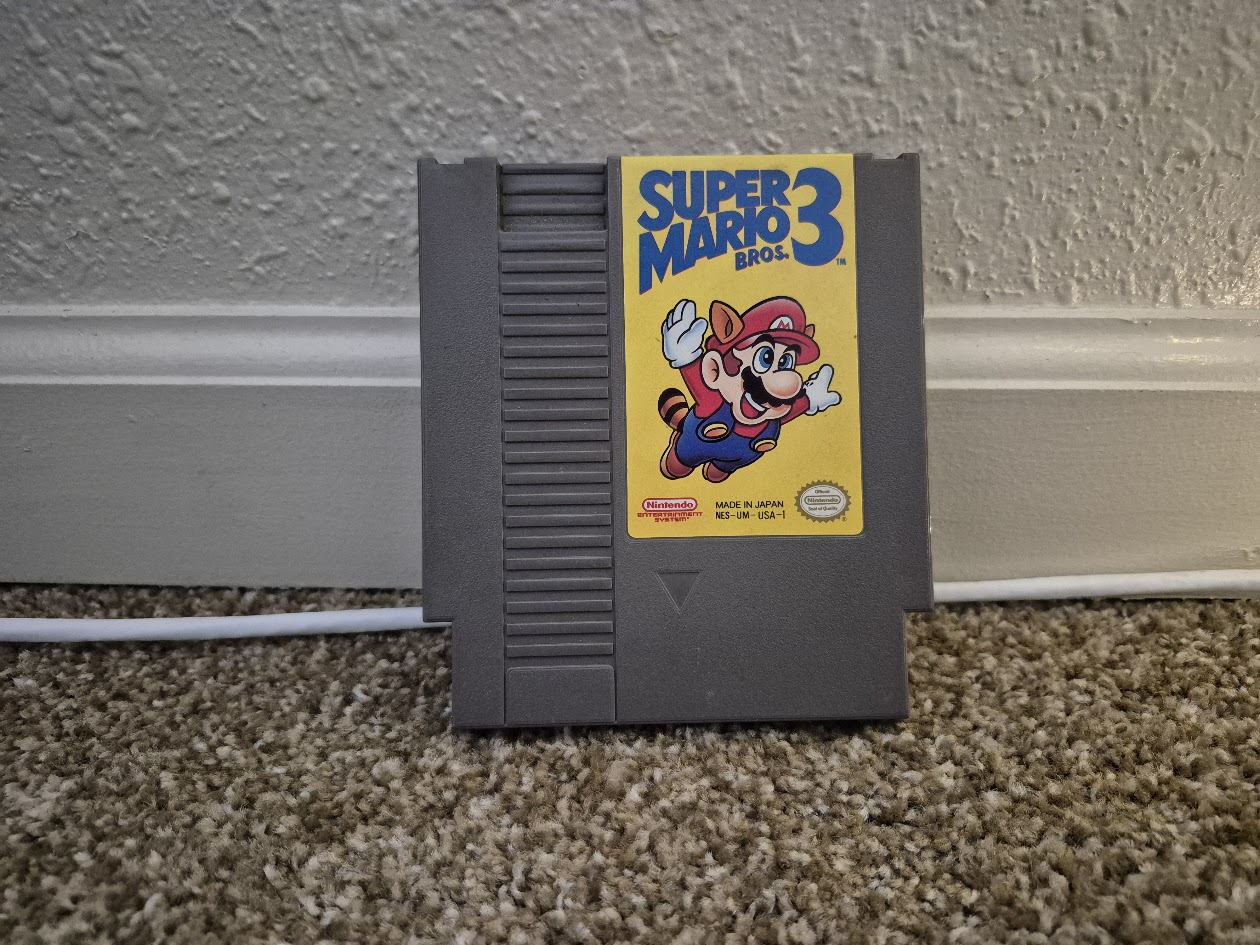
Thirty-five years after its North American release, I take a look back at the innovative power-ups in Super Mario Bros. 3 and how many serve as useful tools during a run of the game.
Released in North America as the final Super Mario game for the Nintendo Entertainment System in February 1990, there’s a lengthy list of ways the iconic platformer changed the genre and video games as a whole for years to come.
While Super Mario Bros. 3 is perhaps my favorite game of all-time and one I hold an unparalleled sense of nostalgia for, I don’t intend for this piece to be a review on everything that makes the game legendary, instead focusing on one aspect here.
After playing a significant, albeit limited role in the first two Super Mario games, power-ups become a focal point of the gameplay in SMB3, introducing the use of items outside of a level for the first time.
The introduction of a new way to use items corresponded with the debut of an overworld map, a feature that would become standard in games of essentially all genres in the years that followed. While on one of the overworld maps, players can use accumulated items prior to entering a level, offering a bit more forgiveness than the series’ two (or three, depending on how you look at it) predecessors.
In this list, I’ll be ranking the 13 items Mario can use out of the inventory at any point in the game based on how useful the items are, also considering their utility in the three different ways there are to complete the game (Any%, Warpless, 100%).
13. Music Box
In what always stood out to me as the game’s most annoying item as a kid, the Music Box maintains that title well into my adulthood. Used to put any enemies on the overworld to sleep, the item is most commonly associated with getting Hammer Bros. to doze off to ease moving around the map.
While the Music Box is useful if your goal is specifically to temporarily facing a Hammer Bros. or Piranha plant, they also don’t get outright get rid of the enemy while replacing the thematic music of each overworld with the repetitive music box theme.
In addition to how limited their utility is, they’re also a fairly common item, being first introduced in World 2 and appearing sporadically from that point on, including as an item from the Princess at the conclusion of World 3.
12. Anchor
The rarest item in the game, the Anchor can only be acquired in white mushroom houses in even-numbered worlds, which themselves can only be accessed by collecting a specific number of coins in a given level in the first seven worlds.
The Anchor, while limited in use, is great for its specific purpose, which is to prevent the airship from moving around the world if the world’s boss is not defeated on the first attempt.
This can become particularly useful if needing to play from a continue within a world or in a larger world with multiple sections, as the airship otherwise could move behind levels that would need to be completed again.
However, if you’re not one to encounter many game overs, it’s hard to see exactly when the Anchor would be useful.
11. Frog Suit
The lowest ranking power-up on the list, the greatest benefit of the Frog Suit is that it provides an extra layer of protection beyond the Mushroom – in that sense, I arguably ranked the item too low.
With that said, the Frog Suit is truly difficult to navigate on land, where the game’s overwhelming majority of levels are, giving a clunky-feeling gameplay that leaves one much more prone to either falling in a hole or getting wounded.
However, the Frog Suit is particularly excellent for one specific level – that being the second fortress in World 3. Being almost entirely underwater with few moving hazards, it’s the perfect stage to showcase the Frog Suit’s intended usage.
Even in other underwater levels, I personally would probably prefer a Fire Flower, as a projectile serves to be more useful in a stage with plenty of moving enemies.
Anyways, here’s someone beating Bowser with the Frog Suit, certainly no easy feat.
10. Hammer
Back to another non power-up item, the Hammer is also a bit difficult to rank, due to its limited but also very helpful usage.
The Hammer is used on the overworld map to knock over a rock to either create a shortcut or reach an area otherwise inaccessible. Its two most common usages come in Worlds 2 and 3, with the former being mandatory for a 100% run of the game, as a Fire Bros. enemy holding a Warp Whistle lies behind the rock that is smashed.
In World 3, the Hammer is used to reach an area of bonus mushroom houses and spade panels prior to the area’s boss battle, allowing the player to stock up on extra lives and items before proceeding.
Outside of these uses, the Hammer holds relatively low importance in the game, and therefore is tough to rank much higher than this.
9. Lakitu’s Cloud
Also known as Jugem’s Cloud, this was perhaps the toughest item on the list to rank, and one that many may feel is too low.
The Cloud, gifted at the end of worlds and in a few select other places, is used to skip over a level on the overworld map, allowing a reprieve if a player is stuck on a particular level they must get past and are unable to clear.
For those just looking to complete the game for the first time, this is a monumental feature, as they can be stockpiled for later worlds where their use is much appreciated for those trying to save lives. While they can’t be used on a world’s final boss, they can be used on fortresses, proving particularly useful for those stuck on World 7’s second fortress and the fortress in World 8.
However, the reason for the item’s low ranking is also the reason I typically don’t use them – they have no use in 100% runs, making them a non-factor for anyone attempting to fully complete the game. While the immediate impact of other items is unquestionably smaller, the Cloud is not quite as useful as other tools found in the game.
8. Super Star
One of three power-ups to carry over from the original Super Mario Bros., the Super Star retains its same purpose in SMB3, giving Mario a brief burst of invincibility and allowing him to defeat enemies by running straight through them.
As an item that can be stockpiled in the player’s inventory, Super Stars are primarily useful when facing Hammer Bros. (also a primary source of acquiring the item) or when the start of a level is particularly difficult for a player, but are without much usage besides that.
The Super Star’s use is highlighted in World 7-7, where Mario must maintain a successive chain of Super Stars in order to complete the level, which is on a floor covered entirely with munchers.
7. Warp Whistle
An icon of the game’s many secrets found throughout, the Warp Whistle is a necessary item for an Any% run and incredibly useful for jumping ahead to a preferred spot in the game.
With only three found in the entire game (two in World 1 and one in World 2, as seen above in the Hammer section), the item is found in a secret location each time, giving players an early opportunity to test their luck late in the game shortly after getting started.
The most common usage of the Warp Whistle is acquiring the first two in World 1 before using both to warp directly to World 8, a route utilized by Any% runners of the game and anyone else looking for the quickest route to completion.
However, if you’re not trying to jump ahead and want to play the game one level at a time, it’s safe to say you won’t be using the Warp Whistle.
6. Super Mushroom
The ubiquitous icon of the Super Mario series and a common item found in this game, the Super Mushroom is equally useful as it is unimpressive when compared to flashier power-ups.
Just as it did in the original Super Mario Bros., the Super Mushroom makes Mario big, while also allowing him to get wounded once without losing a life.
Super Mushrooms are found throughout the first seven worlds of the game, and offer a helpful boost from the inventory when needing a bit of insurance before heading into a tricky level.
However, the Super Mushroom doesn’t have quite the usage of its newer contemporaries, and falls in as a solid, dependable back-up item.
5. Hammer Suit
Perhaps the flashiest and coolest item in the game, the Hammer Suit is part of a group of four new standard power-ups for Mario, joining the Frog Suit and two others still to come on this list.
Not introduced until World 6 and serving as one of the game’s rarer items, the Hammer Suit makes Mario a Hammer Bro himself, allowing him to fire off hammers in a similar manner to fireballs with the Fire Flower.
Though undoubtedly cool-looking and lethal when used correctly, the Hammer Suit also has a bit of a learning curve, with the more-effective hammers not quite following the straight-forward path fireballs do.
At least in my experience, this has led to me losing the suit before I can really ever get started with it, but it can certainly help a player experienced with its feel cruise through a level.
4. Super Leaf
Heavily promoted as the headlining new feature of SMB3, the Super Leaf is introduced in the game’s first level and really never drops off in prevalence, being the only item that can be acquired by Mario outside of a question block in World 8.
A revolutionary power-up for the series and video games in general, the Super Leaf introduces flying to the Super Mario series, allowing Mario to take flight and cover a good amount of ground after getting a running start.
In addition to the two layers of protection and incredible utility the Super Leaf offers, it also opened the door for much of this game’s ground-breaking level designs, expanding on the secrets offered in the series’ inaugural titles by hiding plenty of goodies in spots Mario can only fly to.
This item’s inclusion leads new players to want to fly in just about every level to see what’s hiding, and can lead even experienced players to make new discoveries years after playing.
3. P-Wing
I was admittedly torn on whether to place this as the game’s best item, as it serves as a free pass through completing most levels in the game, but ultimately I still think two other power-ups serve as more useful to the average player overall.
Introduced in World 1 and appearing throughout the game, the P-Wing acts as a Super Leaf with the addition of infinite flight, allowing Mario to fly through an entire level uninterrupted.
While some levels, such as slow auto-scrollers, fortresses and underground levels negate Mario’s ability to skip through on a P-Wing, it can still be utilized on many of the game’s most difficult levels, most notably Worlds 7-8, 8-1 and the fast auto-scrolling World 8 airships.
Though the item can feel like a free pass, Mario is not invincible with a P-Wing, and can be rendered a mere mortal once again after getting hit once while flying – so try not to stay too curious with what’s near the ground when moving through.
Although the item is actually relatively common for how overpowering it is, flying through levels is not the way to truly enjoy the game, and two other power-ups still show more utility across the game’s wide range of levels.
2. Fire Flower
The third and final item on this list to be a carryover from the original Super Mario Bros., the Fire Flower remains an immense aid to Mario, especially in the hands of a skill player.
One of the game’s most common items and appearing frequently throughout, the Fire Flower maintains its purpose from the original SMB, but somehow feels even more useful in SMB3.
In addition to serving as a helpful projectile while navigating through new and more challenging enemies, the Fire Flower also serves as two layers of protection in SMB3, a welcome change from the series’ inaugural game, where Mario will turn small after getting hit just once with a Fire Flower.
Though there really aren’t any levels where the Fire Flower feels useless, it is particularly helpful in water levels, airships and fortresses, the last of which allows Mario to easily defeat Boom-Booms without jumping on them three times.
While not exactly flashy or new to this game, the Fire Flower’s role in SMB3 is instrumental to it becoming one of the most recognizable aspects of the Super Mario series.
1. Tanooki Suit
The game’s most unique item and a fan-favorite on the same level as the Hammer Suit, the Tanooki Suit offers all of the novelty and flashiness of the Hammer Suit with much more utility.
While the Hammer Suit serves as an alternate, in some ways upgraded version of the Fire Flower, the Tanooki Suit serves the same purpose in relation to the Super Leaf, offering Mario the ability to fly along with extra perks.
Initially introduced in World 4 and at its most common in World 5, the Tanooki Suit gives Mario all of the same flying abilities as the Super Leaf does – with the addition of being able to turn into a statue to avoid getting harmed.
While utilizing the latter feature may be difficult for newer players getting used to the suit, this can be incredibly useful for navigating levels, perhaps making Mario at his most formidable in this game with an ability to both fly and avoid damage of nearby enemies.
Though there is certainly a learning curve to using the Tanooki Suit’s statue feature, it doesn’t feel quite as clunky as getting used to a Frog Suit or Hammer Suit does, providing a significant boost for a player learning the game’s power-ups.
Thank you for reading, as I’ll look to continue the Retro Rewind series with more video game-inspired lists, rankings and commentary.
Leave a Reply