As a 29-year-old lifelong baseball fan, it often blows my mind just how much the game has changed over the course of my lifetime and how different the viewing experience is today than it was three decades ago.
From a sport that was powered by a home run and overall offensive boom in the wake of the 1994-95 MLB strike to a second “Year of the Pitcher” in 2014 to the rule changes of this decade, the game has changed more in the last 30 years than in perhaps any period of time in baseball history since the start of the Live Ball era.
Among the most pronounced of these changes have been which statistics are prioritized by fans, players and organizations, and how those priorities display themselves when it comes time for award voting after the conclusion of the regular season.
Up until the past 10-15 years, counting stats reigned supreme in determining who won awards for both hitters and pitchers, with modern metrics such as Wins Above Replacement, OPS+ and advanced defensive stats often being overlooked or ignored entirely.
As I take a retrospective look at each of the major award races of my lifetime, I hope to strike a balance of still valuing the counting stats and “eye test” of the time while also shining a light on the numbers that are more looked at today to see how these races would have shaken out differently. I still value the old adage of “the player who is most valuable to his team” winning the award, but there’s a wide variety of factors that can play into which player has the most impressive season in a league in any given year.
In addition to 1996 being my birth year, I also see it as an ideal place to start this project – it represents the first full MLB season after the strike while also offering an MVP race that exemplifies just how different things are today.
For this, I’ll be showing the actual voting results from the 1996 AL MVP race before re-ranking how I think the top 10 could shake out if the votes were held today.

While Juan González would win his first of two AL MVP awards in 1996, helping the Rangers to an AL West title, I think there’s a good chance the line drive slugger would find himself sitting outside the top 10 if these votes happened today. At least that’s where I have him.
Below is a look at my personal rankings, listed alongside some stats, my reasoning and the change from their ranking in real-life.
10. Edgar Martínez, Seattle Mariners, DH (NR)
Season stats: 6.5 WAR, 121 R, 163 H, 52 2B, 26 HR, 103 RBI, 3 SB, 123 BB, 84 K, .327/.464/.595/1.059, 167 OPS+
The ranking’s lone inclusion that didn’t even receive a single MVP vote in 1996, it’s fair to say Martínez was overlooked, both due to the Mariners missing the playoffs and for having two teammates who somehow managed even more impressive seasons.
Known as one of the most dominant all-around hitters of his era, Martínez’s position as a DH for much of his career often leads to his name being forgotten in the context of great players from the Turn of the Century, but 1996 is yet another reason why Gar is enshrined in Cooperstown.
In his age-33 season, Martínez slugged 52 doubles and 26 home runs, the latter almost seeming lackluster for the era and likely a factor in him not receiving any votes. Beyond the slug, Martínez was one of baseball’s toughest outs, posting 39 more walks than strikeouts while amassing a monstrous .464 OBP.
Despite being a DH and accounting for -1 defensive WAR, Martínez’s 6.5 WAR still dwarfs the 3.8 WAR posted by real-life MVP-winner Juan González. While Seattle ultimately missed out on October baseball in 1996, that blame has to almost solely fall on the team’s lackluster pitching staff, with the Mariners having one of the decade’s finest offenses that season.
9. Mo Vaughn, Boston Red Sox, 1B (-4)
Season stats: 5.6 WAR, 118 R, 207 H, 29 2B, 44 HR, 143 RBI, 2 SB, 95 BB, 154 K, .326/.420/.583/1.003, 150 OPS+
The reigning MVP from 1995, the Hit Dog returned for the full 1996 season with another haymaker of a campaign. While getting edged out by Martínez in terms of WAR and OPS, Vaughn once again amassed the monstrous counting stats that helped him win the award the previous year.
In addition to incredible power and an ability to frequently get on base, Vaughn also showed he was a formidable contact threat as well, hitting at a .326 clip while compiling 207 hits, a mark rarely reached by any kind of hitter in today’s game.
While Vaughn was especially lethal against right-handed pitchers, he didn’t let up much on southpaws either, putting up a .924 OPS against left-handers.
Although season splits show the bulk of Vaughn’s damage was done at home, his situational hitting proved he was one of the game’s most feared sluggers, posting an unreal 1.210 OPS with two outs and runners in scoring position.
Though Vaughn finished 5th in 1996 AL MVP voting, his numbers today are bested by a few seasons that were a bit more complete, particularly on the defensive end, where Vaughn was 0.6 WAR below replacement level.
8. Frank Thomas, Chicago White Sox, 1B (No change)
Season stats: 5.6 WAR, 110 R, 184 H, 26 2B, 40 HR, 134 RBI, 1 SB, 109 BB, 70 K, .349/.459/.626/1.085, 178 OPS+
Just two years removed from finishing off the second of back-to-back MVP wins, The Big Hurt remained one of baseball’s preeminent sluggers in 1996, posting in many ways similar numbers to 1995 AL MVP Mo Vaughn.
Thomas gets the nod over Vaughn in these rankings due to his incredible averages and power production, firing off 66 extra-base hits alongside an elite .349 batting average. While lethal against everyone, Thomas posted an insane .403 batting average and 1.343 OPS against left-handed pitching.
The Big Hurt also bested Vaughn in terms of plate presence, with Thomas, similar to Martínez, drawing 39 more walks than he did strikeouts in 1996, paving the way for an incredible 1.085 OPS.
Also falling in 8th place in the real-life rankings, Thomas is held back from his objectively poor defensive output in 1996, coming in at -1.5 defensive WAR on a team that missed the postseason by just three games.
7. Albert Belle, Cleveland Indians, LF (-4)
Season stats: 5.7 WAR, 124 R, 187 H, 38 2B, 48 HR, 148 RBI, 11 SB, 99 BB, 87 K, .311/.410/.623/1.033, 158 OPS+
One of baseball’s premier sluggers throughout the 1990’s, Belle was in the midst of an otherworldly run during the 1996 season.
Coming off an MVP runner-up campaign that saw him record 52 doubles and 50 home runs in 143 games, Belle returned to put up similar numbers in a monstrous 1996 season, headlining one of the league’s (and decade’s) best offenses.
In addition to being an capable contact bat that led the AL in RBI, Belle was particularly potent away from Cleveland, where he hit .330/.440/.647 with 26 home runs and 16 doubles. Belle also rose to the occasion in clutch situations, hitting .351 with RISP with a 1.302 OPS.
Belle’s superstar output was slightly overshadowed by bad defense, the primary reason for his four-spot fall in my 1996 MVP ballot. His -1.7 defensive WAR, while in left field, still fell well below many of his contemporaries.
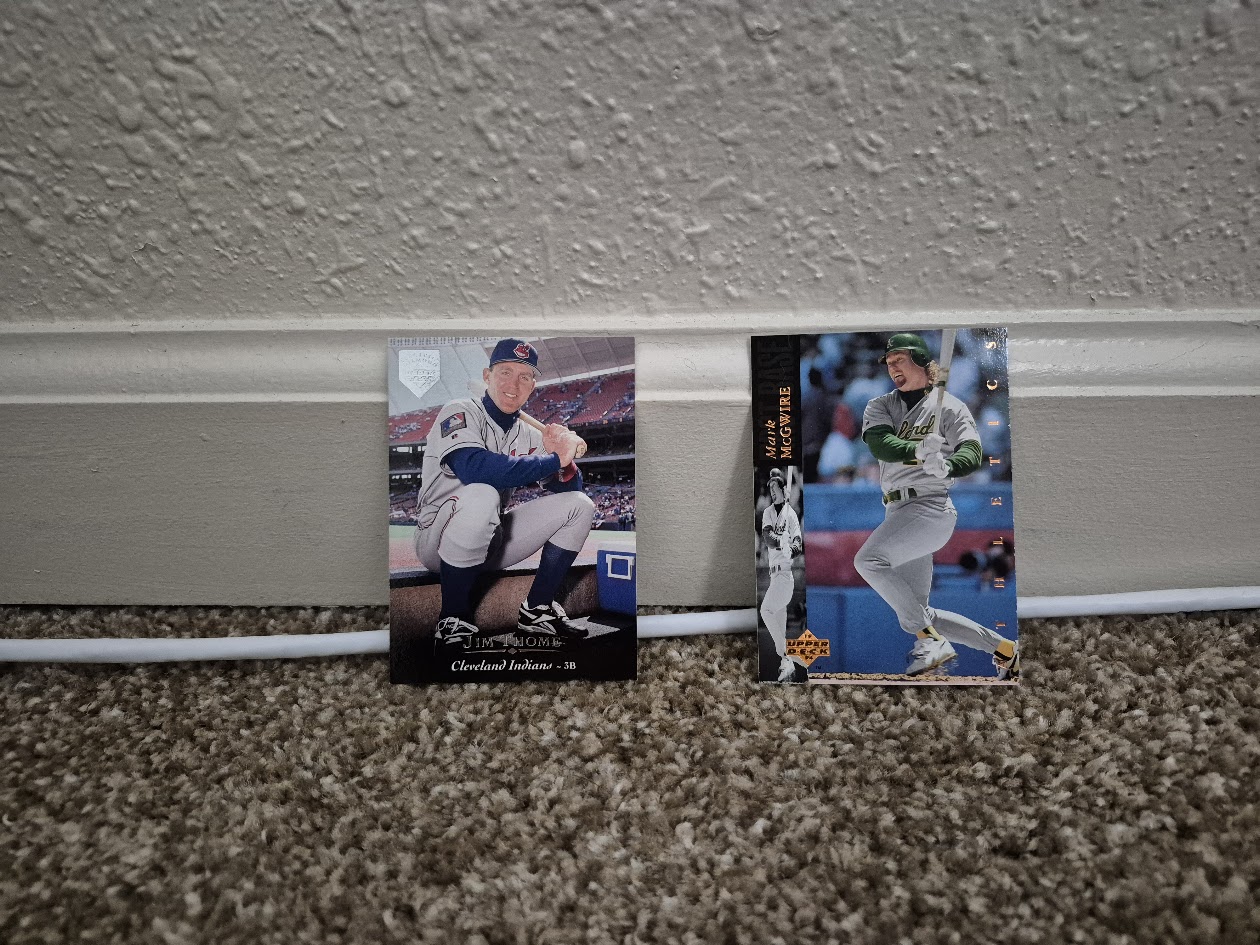
6. Jim Thome, Cleveland Indians, 3B (+9)
Season stats: 7.5 WAR, 122 R, 157 H, 28 2B, 38 HR, 116 RBI, 2 SB, 123 BB, 141 K, .311/.450/.612/1.062, 167 OPS+
While Belle received most of the recognition and attention from Cleveland’s 1996 offense, he was in many ways overshadowed by the breakout campaign of teammate and left-handed slugger Jim Thome.
Though Thome finished 15th in real-life MVP voting in 1996, he was arguably a stronger contributor than Belle on both ends of the ball. In addition to 71 extra-base hits, Thome also drew 123 walks, giving him an OBP 40 points stronger than the already solid .410 that Belle posted.
Although Thome recorded significantly more strikeouts, his higher walk rate and similar power helped to keep a juggernaut of a Cleveland lineup moving with the bases constantly jammed.
Additionally, Thome provided a boost defensively, coming in at 0.4 WAR above replacement level at third base, providing much-needed stability for a club that clearly prioritized hitting in this era.
Thome’s primary drawback to an even higher ranking was his somewhat pedestrian performance against left-handed pitching. While most of his action was against right-handers, Thome hit just .250 with 15 extra-base hits against southpaws, amounting to an at-the-time unremarkable .786 OPS.
5. Mark McGwire, Oakland Athletics, 1B (+2)
Season stats: 6.4 WAR, 104 R, 132 H, 21 2B, 52 HR, 113 RBI, 116 BB, 112 K, .312/.467/.730/1.198, 196 OPS+
In the blossoming of the “chicks dig the long ball” era, there are few people the personify the home run’s popularity than Big Mac himself, and 1996 was no different.
Look, there are several things about this season that players ranked below McGwire did better – his -0.8 defensive WAR and relatively low hits and doubles totals among them. But there is simply no way to ignore how feared and offensively dominant Big Mac was in his final full year in the Bay.
In addition to leading the big leagues in home runs and instilling that fear into pitchers by drawing 116 walks, McGwire truly appeared to be baseball’s scariest hitter in 1996.
While Big Mac did miss 32 games, there was no mistake that he was the focal point of the opponent’s game plan for the 130 times he was on the field. McGwire led all of the majors in OBP, SLG, OPS and OPS+, the kind of offensive dominance that is impossible to overlook.
Though Big Mac was more deadly against lefties than righties, it truly feels like picking your method of death when comparing the two, as McGwire still amassed a .713 SLG and 1.167 OPS against right-handers.
If the defense and the 78-84 A’s were more remarkable, perhaps this ranking would look a bit different – but even with those drawbacks, Big Mac was shorted a little bit with a 7th place ranking in 1996.
4. Brady Anderson, Baltimore Orioles, CF (+5)
Season stats: 6.9 WAR, 117 R, 172 H, 37 2B, 5 3B, 50 HR, 110 RBI, 21 SB, 76 BB, 106 K, .297/.396/.637/1.034, 156 OPS+
Often singled out as one of MLB’s greatest anomaly seasons, Brady Anderson went from a good-hitting center fielder with capable slug to a home run machine in a power binge that only lasted a single season.
Holding a career-high of 21 home runs heading into 1996, Anderson more than doubled that total, slugging a ridiculous 50 home runs as part of 92 extra-base hits as he became perhaps the focal point of a loaded Orioles offense that featured Roberto Alomar, Cal Ripken Jr., Rafael Palmeiro and Bobby Bonilla, among others.
Anderson, who had previously swiped 53 bags in 1992, didn’t entirely let up on the basepaths during the year-long power surge either, stealing 21 bases while also drawing 76 walks, creating plenty of opportunities to advance.
While never seen as a premier defender, Anderson played near replacement level defense in 1996, falling 0.1 WAR below replacement level while posting unprecedented offensive numbers for a center fielder (unless you’re a guy appearing later on this list).
The drawbacks from Anderson’s 1996 season can be found in his splits, which show noticeable drops both at home and against left-handed pitching. While Anderson had a 1.103 OPS against righties and a 1.122 OPS away from Baltimore, those numbers reverted to a still very solid yet noticeably decreased .889 and .952 against lefties and at home, respectively.
3. Chuck Knoblauch, Minnesota Twins, 2B (+13)
Season stats: 8.7 WAR, 140 R, 197 H, 35 2B, 14 3B, 13 HR, 72 RBI, 45 SB, 98 BB, 74 K, .341/.448/.517/.965, 143 OPS+
In perhaps the poster child for how differently seasons would be looked at today, Twins second baseman Chuck Knoblauch jumps 13 spots in the vote to rank third in my redux of the 1996 AL MVP race.
I don’t intend this to be a celebration of any sorts of an objectively awful human being, but rather a reevaluation of how certain stats are seen as more important today and would have impacted a vote like this.
Prior to the legacy of his career being primarily associated with throwing troubles and HGH use, Knoblauch posted some of the most effective seasons from a second baseman in the 1990’s, with 1996 chief among them.
In addition to being one of the league’s best defenders at second base throughout the season, accumulating 1.6 defensive WAR, Knoblauch was a unique juggernaut at the plate in an era of feared sluggers.
While not at all incapable of hitting the ball out of the ballpark, Knoblauch found his success by being an incredibly tough out, combining elite contact and speed with an ability to draw walks. On the basepaths, Knoblauch continued to cause problems, swiping 45 bags and eventually scoring 140 times, the 7th-most runs in a year since this 1996 season.
In a season where this Twins team made the postseason and two other players didn’t have even stronger seasons, Knoblauch could have a strong argument for an MVP award – though his accomplishments are still bested by two teammates.
2. Ken Griffey Jr., Seattle Mariners, CF (+2)
Season stats: 9.7 WAR, 125 R, 165 H, 26 2B, 49 HR, 140 RBI, 16 SB, 78 BB, 104 K, .303/.392/.628/1.020, 154 OPS+
Before injuries became the dominating storyline of the second half of Ken Griffey Jr.’s career, the star outfielder was in the midst of superstardom and pop culture relevance that were both unforeseen for an athlete playing in the Pacific Northwest.
Griffey’s 1996 season, despite coming for a team that ultimately did not make the postseason, is central to his legacy as one of the game’s greatest sluggers and players of all-time.
While Griffey already had two 40-home run seasons to his name, 1996 saw the lefty escalate to new heights, setting a new career-high while posting remarkably consistent numbers across major platoon splits.
Though no one would doubt the impressiveness of Griffey’s 1996 season at the plate, the reason Junior ranks as the 1996 runner-up comes from his generationally great defense in center field, which was on full display throughout the season.
In addition to setting career-high marks in home runs and RBI while still showing plenty of speed on the basepaths, Griffey led all of MLB in defensive WAR in 1996 with 3.4, easily amounting to a career-best.
The result is the kind of season scouts dream of as a best-case scenario for budding prospects – a full campaign in which all of the five major tools are not only on display, but each individually among the league’s best. Crazy that a guy on his team happened to impress even more.
1. Álex Rodríguez, Seattle Mariners, SS (+1)
Season stats: 9.4 WAR, 141 R, 215 H, 54 2B, 36 HR, 123 RBI, 15 SB, 59 BB, 104 K, .358/.414/.631/1.045, 161 OPS+
Often viewed as one of the greatest MVP robberies of the era, a 20-year-old Álex Rodríguez amassed what is still today, one of the greatest seasons ever compiled by a shortstop in 1996.
Take your pick for what’s most impressive about this campaign – be it the otherworldly 141 runs scored, the batting title with a .358 batting average paired with 91 extra-base hits or the AL-leading 379 total bases, and it’s hard to see what A-Rod couldn’t do in his first full season in the big leagues.
The marvel at A-Rod’s 1996 accomplishments extend beyond his work at the plate, as he was one of the league’s finest defensive shortstops all while anchoring a stacked Seattle offense before he could legally drink. As if leading the AL with 8.5 offensive WAR wasn’t enough, his 1.8 defensive WAR was the 10th-best in the junior circuit, regardless of position.
As ridiculous as these numbers see reading them today, I could imagine they were even more insane to process in 1996, prior to the modern day era of widespread power-hitting shortstops, an era ushered in by the likes of Troy Tulowitzki and Hanley Ramírez. In what was traditionally a light-hitting, defense-first position, A-Rod outhit virtually every corner infielder and corner outfielder in major offensive categories while performing at an elite level at perhaps the game’s most difficult defensive position.
Additionally, there were simply no holes in A-Rod’s game in 1996. His OPS was north of 1, be it against righties or lefties, at home or away, on the first pitch or a full count, with high leverage or low leverage – there was simply no favored path to getting A-Rod out.
It’s not like A-Rod would be shortchanged of hardware in his career, as he would go on to win three MVP awards, though his first wouldn’t come for another seven years after this. Though tainted by many due to admitted use of performance-enhancing drugs, Rodríguez would go on to compile one of the greatest careers in MLB history, with an incredible 117.4 career WAR.
Even looking at such an illustrious career with an endless list of marvelous accomplishments, the 1996 season still stands out, even amongst other giants. The kind of season that’s both awe-inspiring, but also, at least for me, reminds me why I love baseball so much – you get to see generational talent seemingly come out of nowhere and change the sport. And while A-Rod was a first overall pick with generational expectations, I don’t think anyone could have reasonably expected an output like that at age 20.
Thank you for reading, as I look to continue this series with the 1996 NL MVP race next.
Leave a Reply