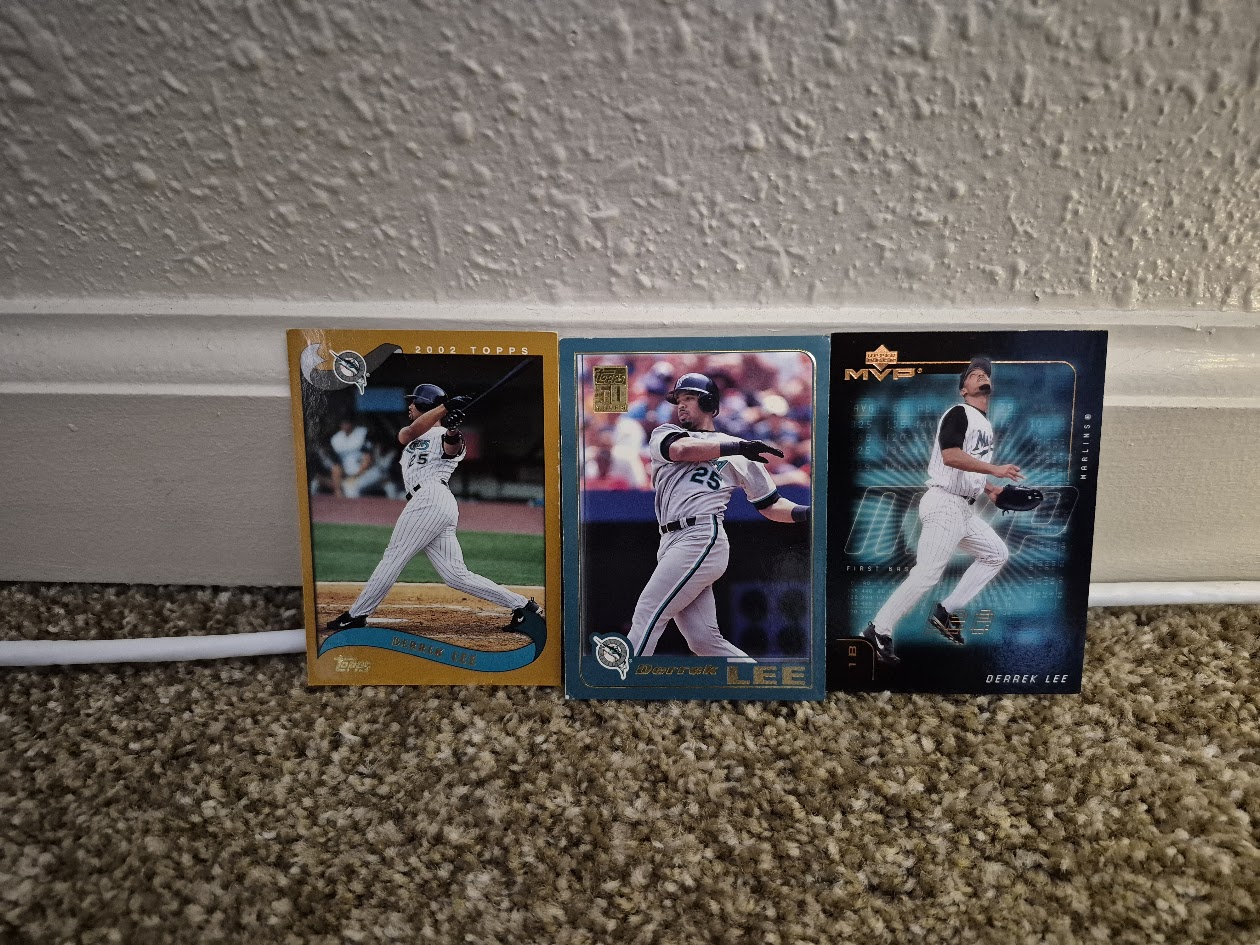
Though it came for a club that finished below .500 and well out of playoff contention, Derrek Lee put up one of the most unforgettable seasons in Chicago Cubs history 20 seasons ago.
Expectations in sports often simultaneously serve as a gift and curse – they offer a set of benchmarks that a player and/or team model their vision of success after, but oftentimes can become the biggest storyline – and distraction.
These expectations were impossible to escape as the mid-2000s got underway in the Chicago area, with the Cubs aiming to make it back to the National League Championship Series after an eighth-inning collapse to the Florida Marlins in the 2003 series, one that is now simply remembered in the sports world as “The Bartman Game.”
A pivotal part of trying to make it back to that moment was looking to shore up a Cubs offense that was clearly the weak link on a team that was just five outs away from winning a National League pennant – so why not poach from the club that beat you?
Derrek Lee was himself a huge part of breaking hearts at Clark and Addison on that October 2003 night – his two-run double immediately followed a costly Alex Gonzalez error on a double play ball that could have ended the inning with the Cubs still ahead 3-1. Yet Lee was more than just a guy with a clutch playoff hit, even at that point in his career.
With the Cubs suddenly having a question mark at first base with Eric Karros heading to free agency, general manager Jim Hendry swapped the young Hee-Seop Choi for Lee in a trade that also involved minor leaguer Mike Nannini.
Though the North Siders entered 2004 with World Series expectations, punctuated by a Sports Illustrated cover predicting their curse-breaking win that season, the team would collapse in September, falling out of a Wild Card spot while finishing 16 games behind the historically great 105-57 St. Louis Cardinals.
Lee’s 2004 numbers at the plate were unmistakably solid – he slugged 72 extra-base hits, including 32 home runs, managing an .860 OPS with 12 stolen bases in a year that was on par with the remarkably consistent start to his career up until that point.
Nobody could have predicted the player the Cubs would be getting in 2005.
After finishing 89-73 in 2004 while missing the playoffs, the Cubs maintained moderately high expectations entering 2005, with hopes of a healthy pitching staff and an offense remaining mostly intact.
In some ways, 2005 served as a sea change for the Cubs – after an unceremonious end to the 2004 season that saw franchise icon Sammy Sosa hit the exits before the final game had concluded, the North Siders parted ways with the slugger while also moving on from outfielder Moises Alou, the latter of whom was a pivotal part of the team’s offense the prior three seasons.
While players such as Michael Barrett, Aramis Ramírez, Todd Walker and Corey Patterson all returned, it was clear that Lee’s offensive role on the team would increase dramatically in 2005 – and the Cubs would need every bit of it.
The healthy pitching staff the Cubs yearned for never came to fruition, with Kerry Wood missing most of the season and Mark Prior also battling injury, though the latter was still able to make 27 starts and put up solid numbers. The offense also didn’t ever fully materialize for the Cubs, with Corey Patterson posting a dismal campaign that included a ghastly .254 OBP as part of an outfield unit that didn’t have a single player hit for an above average season by OPS+.
Yet with all these major problems, the Cubs still won 79 games? They hovered near .500, with this team? Well, yes. That’s where Derrek Lee comes in.
To start from the surface, Lee’s 2005 numbers are truly ridiculous, no matter what era of baseball you’re used to. In 158 games, Lee posted 99 extra-base hits, including 50 doubles and 46 home runs, still swiping 15 bags while compiling a .335/.418/.662 slash line, good for a 1.080 OPS and 174 OPS+, both of which were the best in all of baseball. The efforts were good enough to win Lee a Gold Glove and Silver Slugger award, with a third-place finish in MVP voting.
D-Lee wasted no time in putting the baseball world on notice in 2005, racing out of the gates by going 36-for-86 in April with 16 extra-base hits and a 1.258 OPS. After another great month in May that saw Lee hit .313 with a 1.070 OPS, he would hit over .400 in a month again in June, going 44-for-108 with 12 doubles and seven home runs in the month.
While Lee’s otherworldly season did clearly have a more impressive first act, with a 1.186 first-half OPS compared to a .960 second-half OPS, his value to a fledgling Cubs team was instrumental in finding wins.
This was particularly true in the first half of the season, which saw the Cubs hovering on the right side of .500 before noticeable struggles in July and August, with Lee’s sensational first half paving the way.
When the Cubs did win, it seemed that Lee always had his fingerprints on the victory – the righty slugger hit a video game-like .410/.490/.850 with a 1.340 OPS in games that the North Siders won, with Lee hitting 32 of his 46 home runs in Cubs victories.
Although Lee didn’t quite keep up his first half pace for the rest of the season, he was still incredibly consistent across major platoon splits, performing as one of the league’s top hitters in a variety of situations.
Lee held an OPS north of 1 against both righties and lefties, at both Wrigley Field and on the road and with two outs and runners in scoring position, showing that there was never really a friendly environment for getting him out in 2005.
His value in the Cubs’ wins that season also show in his splits – Lee was a remarkably lethal .401 hitter in innings 7 through 9, posting a .767 SLG and 1.250 OPS in the last third of a game. And while everyone had trouble retiring Lee, a pitcher’s odds were especially thin if they had to face him more than three times – Lee was a deadly 14-for-26 when facing a starter for the fourth time, with eight extra-base hits and two walks.
Though some may attribute this to either/both good luck and/or less optimized defense, Lee was nearly a sure thing when hitting the ball on a line, amassing an .808 batting average on line drives, which included just over half of his 50 doubles.
In a year that represented an unmistakable and distinguished peak in the very good career of Derrek Lee, it’s clear the slugger had nowhere near the help he needed for this Cubs team to succeed, particularly in a division that featured the Cardinals and Astros, two teams that met in that year’s NLCS.
With 7.7 wins above replacement and an MLB-leading 393 total bases, Lee had more than double the WAR of his next-closest position player teammate, with Aramis Ramírez’s 3.6 WAR coming in as the Cubs’ second-most valuable hitter. Outside of Lee and Ramírez, only Todd Walker and Michael Barrett finished the season as above-average hitters as measured by OPS+.
The result was a Cubs offense overwhelmingly anchored by Lee, with even his incredible season not enough to budge the team OPS+ of 95, a significant factor in the club’s struggles that season.
Though the North Siders hoped for an encore out of Lee in 2006, the first baseman broke his wrist in a collision with a baserunner in April 2006, leaving Lee with just 50 games played in a year in which the Cubs finished 66-96.
While Lee and the Cubs would recover from that injury, with the North Siders returning to the playoffs in 2007 and 2008 and Lee returning to All-Star form, the Cubs were swept in the NLDS both years and Lee was unable to replicate the power he showed in 2005.
Lee’s tenure with the Cubs officially came to an end in August 2010, when he was traded to the contending Atlanta Braves for a package of minor league players that ultimately did not have an impact on the Cubs in the years to come.
When it comes to celebrating the Cubs of this millennium, it will almost always center around the magical 2016 campaign that saw the North Siders hold their spot as the best team in baseball all season long en route to a long-awaited World Series title. Yet that team, and no Cubs team in the last 20 years, had a player anywhere as dominant as Derrek Lee was in 2005 – yes, that includes 2016 MVP Kris Bryant.
It’s hard to imagine where the 2005 Cubs would have finished without Lee – and considering they finished 79-83 with him, maybe it isn’t worth much thought in the first place. But two decades after Cubs fans were treated to one of the most complete offensive seasons by any player in recent memory, it’s only right to acknowledge the level of greatness that would have been celebrated across the sport had it come for a winning club.
Leave a Reply