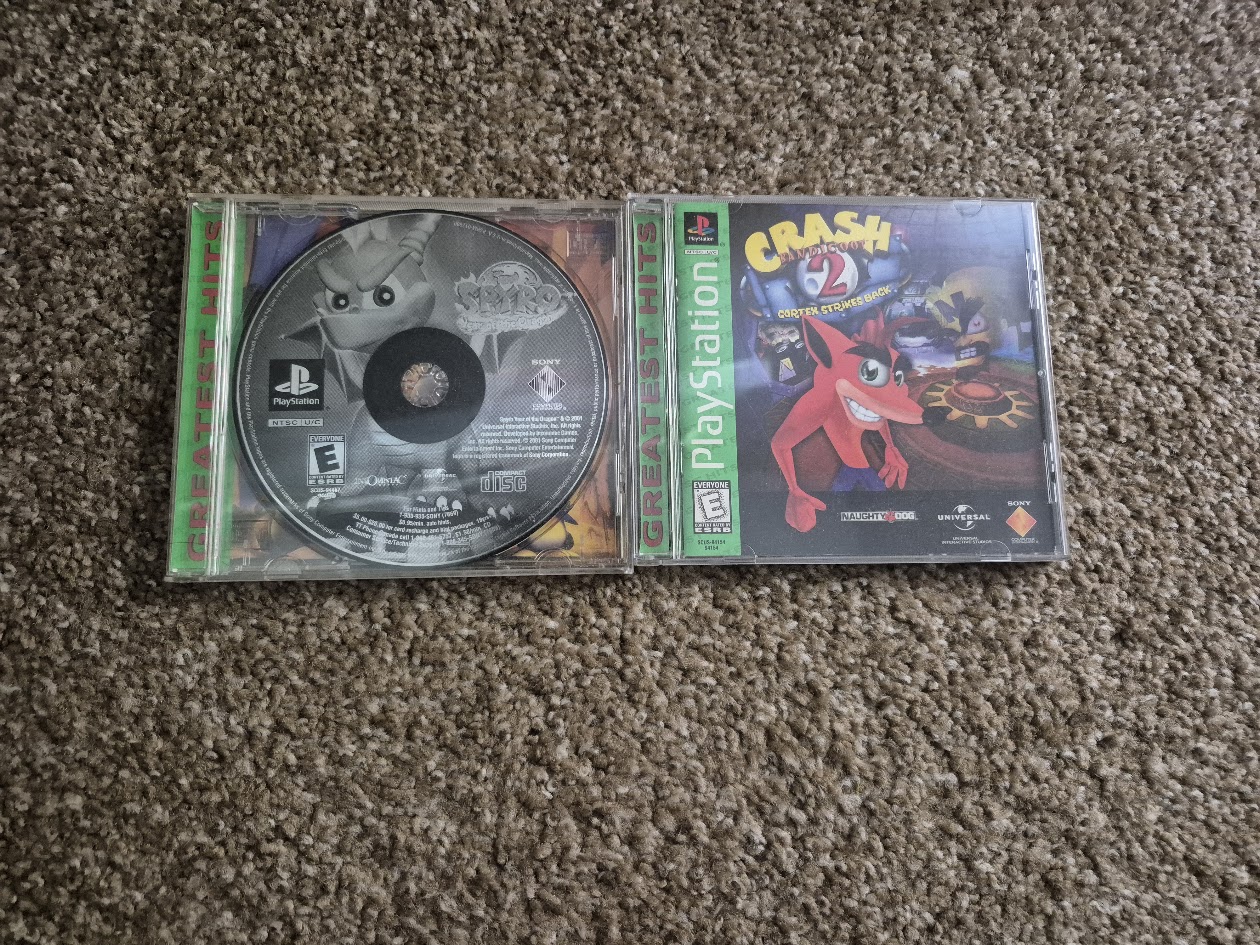
As I revisit some of the most beloved games from my childhood, here’s a look at how I’d rank the six platforming games that put the PlayStation on the map for children and families.
The phase of my wife and I being glued to our computers gaming on Steam has dominated much of the summer and has showed no signs of slowing down for us as we both dive into a mix of familiar and unfamiliar games to pass by the days of searing heat in California’s Central Valley.
While my wife just finished up the main storyline to Cyberpunk 2077 and has been gripped by simulation titles Planet Coaster and Planet Zoo, I’ve done a deep dive back into the Crash Bandicoot and Spyro trilogies, largely thanks to their remastered editions both being on Steam.
After playing all six of the trilogies’ games as a child on the PlayStation, it’s been incredibly fun to revisit the games sporadically over the years, with this summer marking the most time I’ve spent on either series since the start of the COVID-19 pandemic.
Wednesday marked a completionist milestone on one of those fronts, as I finished off all 105 achievements for Spyro Reignited Trilogy, while also collecting every gem, dragon, dragon egg and orb the three games have to offer.
Though it will be a very long time until I am able to do the same for Crash Bandicoot N. Sane Trilogy (if ever), the trip down memory lane has also allowed me to revisit the many levels of the Crash series, some of which I have always done my best to avoid in the past out of sheer annoyance.
While these games are still among my favorites at 30 years old, they’re obviously far from novel experiences for me – though it is worth mentioning that the six games aren’t exactly on an even playing field when it comes to my memory and personal experiences.
Perhaps owing to the fact that I was a bit on the younger side when these games were originally released, I was introduced to both trilogies in reverse order. My family had purchased Crash Bandicoot: Warped not long after getting a PlayStation in 1999, while my curiosity over Spyro led me to get Year of the Dragon at some point in early 2003 – with me playing the earlier four games of the trilogies at later times after getting bored of Warped and YOTD.
Although my recent experiences with the games have been on the excellent remastered versions, this ranking will reflect the original PlayStation games – as I feel like most feedback on the trilogies surrounds their faithfulness and accuracy when compared to the original titles.
This ranking is ultimately just my opinion and is largely based on my personal experiences, but I’ve aimed to bring some shade of objectivity to the process. I’ll be considering the games’ difficulty, level design, graphics, controls and music among other characteristics in the rankings of these titles.
With both series remaining widely celebrated among new and old gamers alike decades later, here’s how I would rank the six games of the original Crash Bandicoot and Spyro trilogies:
6. Crash Bandicoot
This of course is a take I expect to be met with vehement disagreement with those who remember playing this game when it came out, as opposed to me already having the picture of the more advanced Warped in my head when I played this for the first time.
I don’t want this ranking to imply that I think the opening Crash Bandicoot is a bad game, especially as it has continued to build a reputation as one of the more influential platformers of its generation.
Featuring a unique 2.5D layout that took advantage of the PlayStation’s technological capabilities, the game is set in a chain of islands off the coast of Tasmania in Australia – with the game’s surroundings perfectly fitting with the series mascot who himself is influenced by the animals of The Land Down Under.
One of the defining features of Crash Bandicoot is its incredibly linear and unforgiving nature. All levels are played in the same order in each playthrough, meaning if you are stuck on a given level, there is no way to move forward in the game without completing it. While the N. Sane Trilogy’s autosave feature helped alleviate some frustration for new players, the original PlayStation version only features savepoints after select levels – only adding to the immense frustration.
Crash Bandicoot being ranked last of the two trilogies is moreso a product of its successors simply being more polished than the raw, original game players were introduced to in September 1996.
The game’s most significant drawback is undoubtedly its difficulty. While this can turn into a strength for advanced platform gamers who love a challenge, I have a hard time picturing young kids enjoying this game far beyond the first two or three levels. Not only are many levels very difficult themselves, but completionist players have an entirely new challenge on their hands if they seek 100% completion – with box gems for several levels requiring the player to break every box without dying to earn the gem.
Additionally, while the game’s level design is undoubtedly a strength that showcased unique styles and hazards, the distinct nature of levels diminishes as the game goes on. Particularly in the latter half of the game, there is a high volume of levels that take place in dark settings – a characteristic that gets old quick when trying to grind through the end of the game.
While I deeply appreciate the game and its legacy, the original Crash Bandicoot has almost always been more frustrating than fun, with a learning curve that’s simply too high to quickly appeal to an everyday casual gamer.
5. Spyro the Dragon
The other trilogy opener takes the fifth-place spot in these rankings, in what is once again a ranking that should be viewed more as a glowing review of its successors rather than a pointed criticism of the original Spyro.
In many ways, this game and the Spyro trilogy as a whole aimed to widen what was possible within a 3D platforming environment, with the distinct differences between the Spyro and Crash Bandicoot series becoming immediately apparent upon landing in Artisans, the game’s first level.
Differing greatly from the strictly linear homeworld and levels of Crash Bandicoot, Spyro the Dragon appears to take a page out of the Super Mario 64 book, offering players more of an open-ended sandbox environment in both homeworlds and levels.
While the game remains linear in the sense that certain prerequisites must be met to advance to another homeworld, Spyro gives the player plenty of freedom to both explore and defeat which levels they prefer when they want – even ignoring some entirely if you’re not one to care much about fully completing the game.
This title’s drawbacks mostly revolve around Spyro’s limitations that were alleviated in the trilogy’s next two games. Spyro is unable to hover, swim, climb ladders or headbash, abilities that all become a standard part of the purple dragon’s repertoire in the following titles. As a player accustomed to the other two games in the trilogy, the absence of these abilities can grow annoying at times, especially in some parts of the game that feature technically demanding jumps and glides.
This game also features incredibly boring excuses for boss fights, which kind of serves as a momentum killer when reaching the end of a homeworld, as well as the irritating inclusion of enemies within the homeworlds – which gets very old when having to deal with respawning enemies when you’re just trying to get to another level.
Thankfully, the later two games fixed this by removing enemies from homeworlds, easing travel between levels.
Spyro the Dragon is a ton of fun and an excellent addition to the platforming genre, but its two successors greatly improved on the game’s weaknesses.
4. Spyro 2: Ripto’s Rage
The toughest decision of this list was sorting out my rankings for third and fourth – and it still feels a bit weird because I personally do prefer playing Ripto’s Rage to the game I chose for third place. But in an effort to bring some level of objectivity into this, I do place Spyro’s sophomore effort in fourth place.
A noted improvement from the first game, Spyro learns a range of new abilities throughout the game while players are introduced to several characters that later become a fixture in the Spyro series, such as the Professor, Hunter and the game’s primary antagonist, Ripto.
Ripto’s Rage is notably a short game, which certainly comes across as a slight weakness when comparing it to the other two titles in the trilogy. The game features just three homeworlds with a main storyline that’s fairly quick to traverse through, with a player needing to collect 40 of the game’s 64 orbs in order to defeat the final boss and complete the primary portion of the game.
When it comes to level design and music, this game is a marked improvement over its predecessor, with levels that feel more immersive and in-depth while also including minigame tasks that are required to collect several of the orbs hidden throughout the game.
So, outside of being a bit short, what are the problems with Ripto’s Rage?
Ultimately, to me, it boils down to two characteristics that are unique to this game within the Spyro trilogy. First, Spyro does not receive gems for killing enemies, but rather particles that are used towards deploying in-level powerups. While this unique system is a prized point of difference from the original game, it can make gem hunting a bit more irritating when knowing enemies don’t contain them – which could lead to players ignoring them outright and giving themselves a tougher time when backtracking.
Which leads into the second drawback, which is the backtracking. Due to Spyro learning certain skills throughout the game (swimming in the first homeworld, ladder climbing in second homeworld, headbashing in third homeworld), the player is required to backtrack to past levels at several points in order to fully clear a stage. For players that prefer 100% clearing a level before moving on, this can be irritating and makes what should be a short game feel unnecessarily longer.
Still, these are ultimately very minor complaints to lob towards a game that was an incredible improvement over its predecessor and one of the best platformers of its generation.
3. Crash Bandicoot 2: Cortex Strikes Back
The game of the Crash trilogy I’ve been playing the most of in recent weeks, this game is a measurable improvement over its predecssor in just about every way, not unlike Ripto’s Rage.
A title that introduced many long-term elements of the series from the iconic warp room and riding Polar to the slide jump, Cortex Strikes Back does an excellent job at finding ways to bring new players into the fold without sacrificing too much of the trademark platforming difficulty that earned the first game many of its dedicated fans.
While the more nonlinear nature of the game allows players to choose one of five levels to start with in each of the five warp rooms, the average player will still almost certainly run into some difficulty later in the game – with a 100% run of the game even more demanding when considering what goes into collecting every gem in the game.
The title also features a notable improvement in boss fights while introducing several villains that would become some of the series’ most recognizable characters, including Tiny Tiger, Komodo Joe and Dr. N. Gin. The level design takes a noted step forward as well, with new inspirations such as sewers, space stations and bee-infested forests bearing fruit in some of the game’s levels.
Topped off with an iconic main theme and several infectious tunes heard throughout the game’s levels, there just aren’t too many places where this game went wrong – with most of its “weaknesses” simply revolving around features added to Warped that weren’t yet present.
2. Spyro: Year of the Dragon
My first introduction to the series and the last installment of the original trilogy, Year of the Dragon is a stunning culmination of all of the amazing elements introduced in the first two games with a horde of additions that still feels tasteful as opposed to overboard.
Starting as an adventure that pits Spyro on a mission to reclaim missing dragon eggs spread throughout the “forgotten realms,” players are given everything that made the series great in its first two games with a healthy amount of additions that truly make it feel like a definitive step forward.
The most obvious of these adds is the introduction of four new playable characters, with each one corresponding to one of the title’s four homeworlds. After all being captured by Moneybags, the cash-hungry bear that initially ran Spyro dry of gems in Ripto’s Rage, Spyro works to release all four of the characters, which allows them to be playable both in their own level and in a set of minigame sections in other levels scattered throughout the game.
While this does lead to some minimal backtracking, it’s not quite as pervasive as it was in Ripto’s Rage, while also not quite having the same effect, as players backtracking in Year of the Dragon are doing so to explore a part of the level that was previously inaccessible.
As if the characters weren’t enough, Spyro gets introduced to a range of playable vehicles as well, ranging from the beloved skateboard to submarines and tank blasters that make appearances in select levels.
Though difficulty isn’t a huge barrier similar to other Spyro games, a 117% run will still take quite some time, with a few select eggs known for being particularly difficult to collect.
For me, this game has everything that made me fall in love with Spyro. Optimistic, bright music that signals the start of a new journey, colorful, immersive levels that are addicting to explore and a variety of new features and abilities make this game feel as refreshing in 2026 as it did for those that played it upon release in October 2000.
1. Crash Bandicoot: Warped
One of the first games I was introduced to as a child and a timeless classic 28 years after its original release, Crash Bandicoot: Warped not only stands out to me as the finest game of the two trilogies, but perhaps is the best non-Super Mario platformer of all-time.
A measured step forward from what were already massive improvements seen in Cortex Strikes Back, Warped revived the warp room feature with a bit more connectivity to the game’s plot and storyline – which is framed as a mission to travel through several distinct eras and collect crystals, gems and relics in an effort to triumph over series antagonists Dr. Neo Cortex and Uka Uka.
This theming plays a significant role in the game’s level design, which evolves from the more medieval-inspired themes from the first warp room to the flashy skyline of the fifth warp room that bleeds of Y2K futurism influence.
The quality of life additions and improvements to this game are numerous and noticeable to casual and dedicated gamers alike. After making her debut as a side character in Cortex Strikes Back, Crash’s sister Coco debuts as a playable character in several levels in Warped, with Coco taking on new modes of transportation such as a jetski, Pura the tiger and a battle spaceship used in the game’s most intense boss fight against N. Gin.
That of course doesn’t even mention the inclusion of relics, which test a player’s ability to complete a level in a given amount of time and went on to become a staple of the series, nor the numerous powerups that are earned after defeating a given boss, which range from an extended spin to a Wumpa Fruit bazooka that can help Crash attack enemies from long-range.
It all comes with a true earworm of theme music that has persisted in the series since the release of this game, with several level themes contributing some catchy tunes themselves, including the call-and-response riff in Egyptian-themed levels and the tech-influenced electronica heard in Future Frenzy and Gone Tomorrow.
This game is endlessly enjoyable for all gamers, with the main storyline not being too technically demanding on players while a full completion of the game still takes true platforming dedication.
There is great reason that this title emerged as the crown jewel of PS1 platformers, and its legacy held in the gaming world today is incredibly well-earned.
Leave a Reply