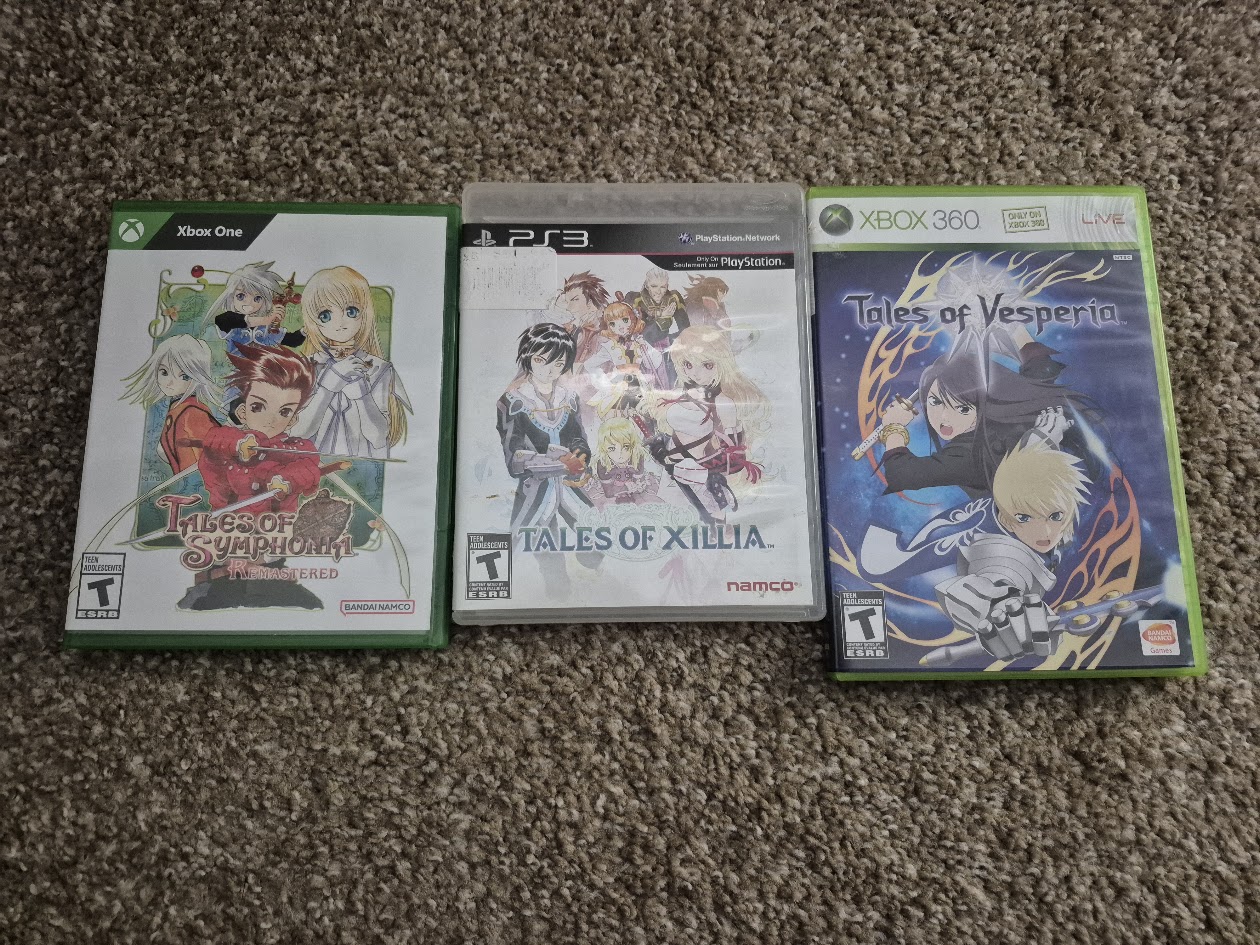
One of the most recognizable JRPG franchises in the world, several games in the Tales series remain exclusive to East Asian countries, shutting out its much smaller but dedicated Western fanbase.
Despite Tales of Symphonia being just about my favorite video game of all-time, I had never really done a deep dive on Japanese RPGs in the 22 years since Symphonia’s North American release.
Outside of some dabbling with Final Fantasy VII as a child, I simply stuck to platformers and adventure games despite me loving just about everything that those two games entailed.
Between a gripping storyline filled with surprise twists, a world that sees the characters in your party develop over time and a leveling system that rewards patience, it was quite easy to find myself absolutely lost in either of those games. Yet still, I just never really sought out more of where that came from.
Despite owning copies of several Tales and Final Fantasy games that I have yet to play through on a console, it was a recent Steam sale that finally got me to broaden my horizon in the JRPG world, picking up the definitive edition of Tales of Vesperia for just $9.99 earlier this month.
In the weeks since buying the game, I’ve been absolutely hooked as it has brought back incredibly nostalgic memories of playing through Symphonia for the first time as a child. Maintaining all of the same characteristics that made me fall in love with ToS while including some noticeable quality-of-life improvements from the earlier title in the series, it’s no mystery that Vesperia is often listed alongside Symphonia near the top of fan rankings of the series – and I say that having only played through around a third of Vesperia so far.
My immediate affinity for Tales of Vesperia made me wonder – what is next?
In many ways, this is an incredibly exciting question for a gamer to ponder. Here is this entire genre that I’m discovering I truly do love, with entire series full of untouched adventures waiting at my fingertips – and thanks to the nonlinear, disconnected nature of both the Tales and Final Fantasy series, it isn’t like I need to start at the beginning.
Here’s what’s crazy though – if I wanted to, I actually could do that with the massive mainline lineage of the Final Fantasy series, thanks to the entire primary series being available in some way or another on PC.
I had noticed this just around a week ago, when I was trying to compare the Final Fantasy games I could play on my PC to whatever remaining Tales games I could make my way through on Steam. While Tales of Xilia, Tales of Berseria, Tales of Zestiria and Tales of Arise are all available on Steam, many of the series’ older titles are only available on their original consoles – with several other titles in the series having never received a North American or European localization at all.
This isn’t the first time I’ve wondered about this in regards to the Tales series, previously having developed an interest in Tales of Phantasia, the landmark opening title of the series that Tales of Symphonia serves as somewhat of a distant prequel to. Released exclusively in Japan for the Super Famicom while later receiving a PlayStation port, ToP didn’t make its way into North America until 2006, when it received a Game Boy Advance port – needless to say, not the most ideal way to play a JRPG.
While starting at the top of the Final Fantasy series and working one’s way through is as simple as buying the games in order on Steam, doing the same for Tales would have to involve ownership of Japanese consoles and likely some deep pockets as well.
The second mainline Tales game, Tales of Destiny, was a PlayStation exclusive released in Japan in 1997 before making the series’ western debut the following year, where it was met with a rather lukewarm commercial performance – which perhaps influenced the series’ timid relationship with the west.
The game remains one of the rarer PlayStation games in North America today, with complete-in-box copies of Tales of Destiny selling for nearly $150 per copy, meaning starting the series where it began stateside is not exactly going to come at a bargain.
Although all recent titles have received localizations and have performed relatively well commercially, earlier games in the series remain elusive to its overlooked western fanbase, with multiple mainline titles remaining entirely inaccessible to the North American and European audiences.
The following mainline Tales games have still yet to receive a release on any platform in North America:
- Tales of Destiny 2 – 2002
- Tales of Rebirth – 2004
- Tales of the Tempest – 2006
- Tales of Innocence – 2007
While I’m far from a tech expert who is knowledgeable about how ports like these are made, I have a hard time believing that a group of games that have been out for around two decades would be all that difficult to port to at least the PC – with the challenge likely coming from the language localization.
Yet with games this old, I don’t think dedicated fans of the series would be holding out for voice actors or any over-the-top catering to a western audience – it’s as simple as people wanting to be able to experience the games firsthand.
I wouldn’t expect this to be a blockbuster financially for Bandai Namco, but it’s also the kind of endeavor that could bear fruit in the long-term by creating new fans of the series in places that the games previously didn’t have much reach in.
Furthermore, it feels like the time to jump in on something like this would be right now. While another Tales game is said to be in development, the main series has been without a release since September 2021.
Though the 30th anniversary of the series itself has come and gone, there’s still ample opportunity to capitalize on an anniversary in 2027 or 2028 by tying it to the original Japanese and North American release dates of Tales of Destiny – a game that could purely be ported without the need for language localization.
Despite its rampant popularity in Japan, the Tales series has always taken a back seat to Final Fantasy among western audiences – and a full series release is the kind of thing that could make more gamers, those into JRPGs and those that aren’t, want to dive in to experience something new. With a greater emphasis on character development than the more story-based Final Fantasy games, players will likely come away looking at the two series as rather distinct experiences.
Maybe this is just a pipe dream. But in an era of remasters and Steam ports of older games being commonplace, I’ll continue to hold out hope.
Leave a Reply