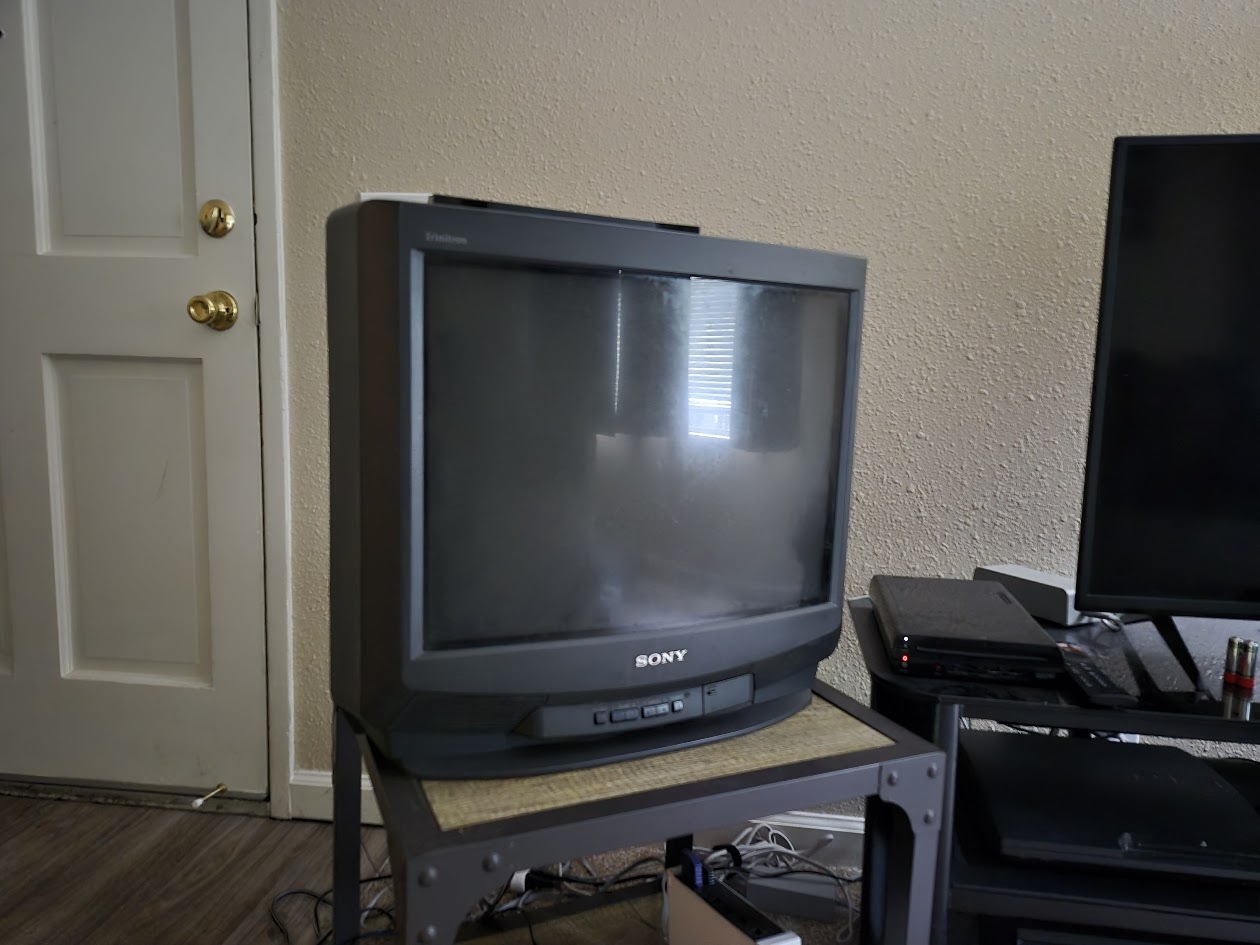
Though long obsolete by conventional standards, the CRT TV remains an essential for our collection – and it isn’t just about the games.
Within the past five years, anytime my wife and I have had a visitor to our apartment, we’ve been peppered with questions as soon as our gaudy Sony Trinitron from 1997 catches someone’s eye.
“Woah, I haven’t seen one of those in years! Why do you have that?”
“Do you actually need that to play old video games?”
“Isn’t it way too heavy?”
Beyond the CRT TV’s insane weight and awkward shape, there’s much more that the old technology brings to those looking to play older video games. Despite televisions being larger and more technically impressive than they’ve ever been, the ideal way to play older video games is still to do so with the televisions that were commercially available at the time.
Being 30 years old, I grew up with CRTs being ubiquitious for quite some time before high-definition plasma and LCD screens began to gain popularity and market share over the long-time titan. While CRTs are synonymous with retro video games today, it can be easy to forget that they remained the predominant form of television set in the United States into the late 2000’s before HDTVs reached a low-enough price to convert the last of the CRT hold-outs.
For the uninitiated, CRT stands for cathode ray tube – meaning the TV’s display is made possible by a vacuum tube that contains electron guns which fire electrons that are then directed and controlled to be displayed on a screen. This of course vastly differs from the flat-screen TV technology of today, much of which is LED-based.
It is worth noting that we did not begin our video game collection already with a CRT – meaning we both had plenty of time to notice the difference that exists when playing old video games on modern HDTVs.
While adapters exist that allow conventional AV-to-HDMI conversion, affordable versions of these converters often result in noticeable lag and poor resolution on the HD TV – which of course, isn’t all that different than what happens when you simply plug the AV cables directly into an HD TV.
Though the extent of the lag varies from TV-to-TV, there are some games where even the smallest bit of latency issues can make them feel unplayable – especially for me now, having grown accustomed to playing on a CRT TV.
This distinction is most well-known within the Super Smash Bros. Melee community, with tournaments and top players exclusively using CRT TVs to this day largely due to their lack of latency issues.
It may sound like that’s only a deal-breaker for elite players, but after having played Melee on a wide range of HD TVs with varying latency issues, even casual players are likely to notice some delay when playing.
Latency issues were also prevalent in rhythm games, with early Guitar Hero and Rock Band games being released in the late 2000’s while the TV market was in a moment of transition from CRT to flat-screen. While early games of the series played on a CRT would offer crisp, instanteous display corresponding with a player’s input, the advent of HD TVs required players to calibrate their game’s lag to help ensure that the notes on the screen aligned with the music being played.
Beyond always having your actions on a controller perfectly sync up with what you’re seeing on the screen, it shouldn’t be lost on anybody just how good display on a CRT looks with old games to this day.
While our CRT model only includes one set of inputs and does not have the component ports that some later CRTs do, those that do include component ports can provide perhaps the cleanest resolution one can find on an old TV with a 480i display.
So if we didn’t start our collection with one of these, how did we stumble across a CRT and what made us decide to get the one we did?
As is the case with inheriting old belongings oftentimes, it turned out the only decision that was made was simply answering a yes-or-no question.
During a visit to my father’s house in the Chicago suburbs in early 2021, I was asked if I wanted the Sony Trinitron that belonged to my late grandmother for a number of years. She had just died in December 2020, and I was already over there to pick up a few keepsakes to have around in her memory. Yet I don’t think anything I could have gotten would have reminded me of my grandma as much as this CRT does today.
While I’ve alluded to it previously in past writing, my grandma loved the old 2D Super Mario Bros. games. After having seen my dad and uncle play the games obsessively upon their releases in the late 1980’s and early 1990’s, my grandma eventually decided to get in on it herself – doing so years before I was born in 1996.
By the time I could pick up a controller myself when I was a toddler, my grandma had become a wizard in Super Mario Bros. 3, able to breeze through the game with little interruption or trouble thanks to years of it being a universal site at family gatherings.
Her love of the Mario games eventually led my dad to gift her the NES he originally had, serving as the primary reason why most of my nostalgia with early Mario games is correlated with the SNES version of the titles on Super Mario All-Stars.
Therefore, everytime I look at the CRT TV in my living room, I’m reminded of the countless memories I had with my grandmother playing Mario, from being a toddler and having her guide me through tough levels to being a high school student, turning on her NES during a visit to her house to just play the game, reminisce on old memories and spend good time together.
My grandma should be turning 87 today – she was in poor health for a number of years and died on December 4, 2020, what ultimately went down as one of the deadliest days in American history at the height of the devastation wrought by the COVID-19 pandemic.
I remember the flood of memories rushing back to me when saying goodbye to her on the phone and learning of her passing. She was a constant fixture in my life growing up and was around for so much – beyond seeing her at family gatherings, my dad and I visited her every Sunday for years while she would stay at the house I grew up in while my dad was out of town for work.
Yet the first things I remembered in that extreme moment of grief and sadness were the countless memories we had playing Mario together – much of which was on the exact same CRT sitting in our living room today.
For those that don’t have a CRT TV, your best bet is to simply get lucky – find someone on Facebook Marketplace or in a neighborhood group that’s trying to get rid of a monstrous screen they don’t know the worth of. Take a look on eBay or find one in a old store, and you’ll almost certainly be met with triple digit pricetags.
That’s around what our Sony Trinitron from 1997 would be worth if we decided to part ways with it – but we never would. Sure, it’s incredibly useful and we play old games on it on a near daily basis. It makes collecting easier and hosting friends for a retro game night feel like a trip back in a time machine.
Yet what makes it invaluable to me are of course the years of memories associated with it, from a time that drifts further away with every day. As a 30-year-old who is still deeply in touch with the same things that made me happy as a kid, it truly feels like an immense privilege to be able to hold on to a link to memories I hope to never forget.
Ultimately, that’s what gaming should be all about, and what it was meant to be about when consoles first made their way into the average American living room in the 1980’s. It’s a communal, familial experience – one that can have a legacy that means much more than a basic game from a time long ago that hardly resembles the world we know today.
Yet all we can do is take ownership of the things we can control while finding ways to both distract from and triumph over the uncertainty that clouds everyday life today.
Speaking from personal experience, there are simply few ways to feel better than to get in touch with some of your favorite memories from long ago – and thanks to all of the same games and the same TV sitting in our living room today, my wife and I get to continue making memories in the same exact way.
Leave a Reply