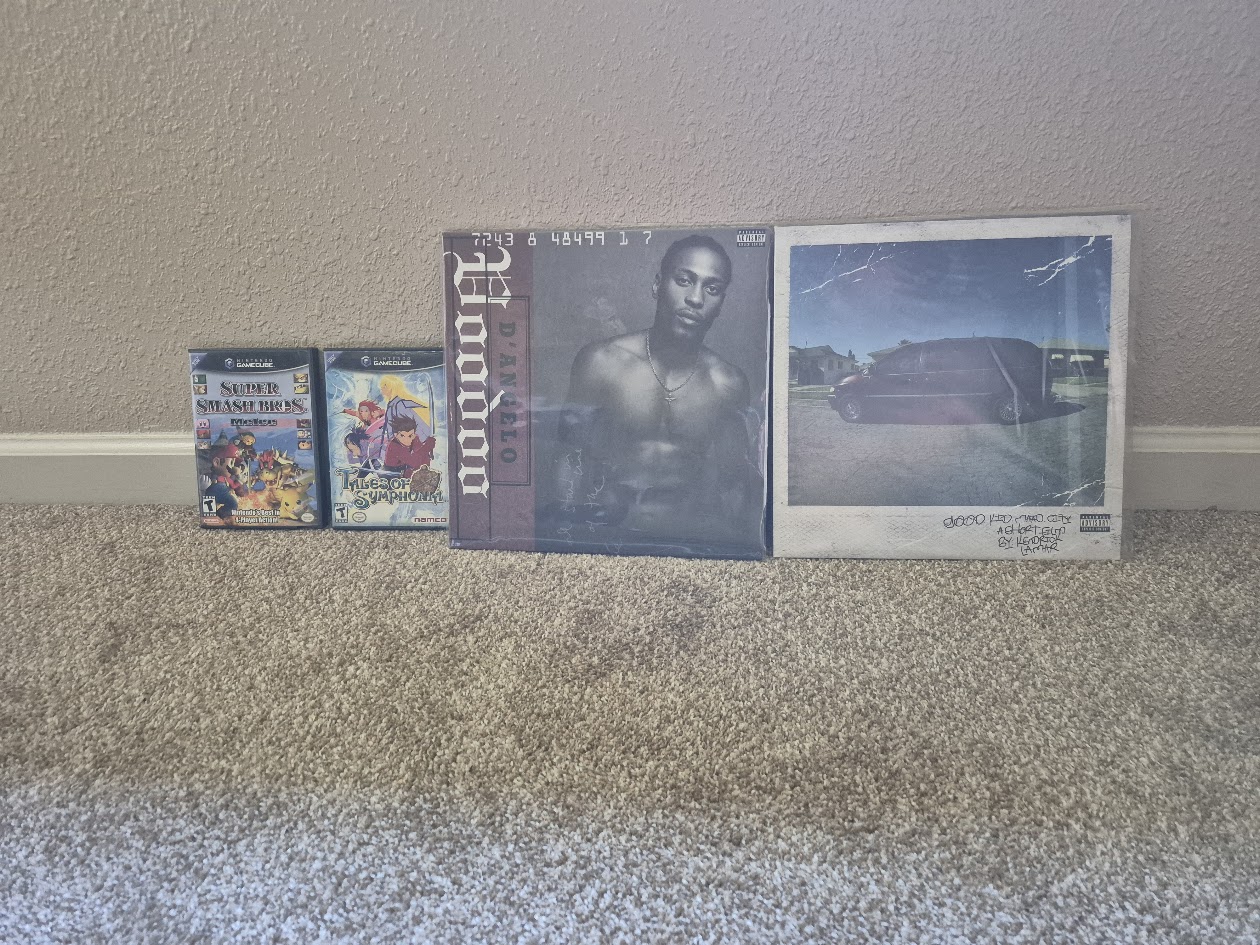
In an era of endless options of TV and movie on streaming platforms and digitally downloaded games, I still can’t let go of physical media.
Growing up during the turn of the century and early 2000s, physical media was one of the ubiquitous elements of popular culture – from elaborate home entertainment systems to zig-zag CD towers and displays of video game consoles, it felt like a part of life that would simply never fade away.
Whether it be video games, music or film, physically owning a favorite movie or game was not only considered an integral part of fandom, but a central feature to having a good time with friends and family inside the home.
As a child, video games were certainly the media form I pursued the most – I grew up in a Mario household, with an SNES in the living room by the time I was born – but there was much more than that in this average American household. A large stack of VHS tapes consisting primarily of Disney movies and a CD booklet filled with everything from Wolfenstein 3D to Millennium by the Backstreet Boys was easy to find.
Fast-forward a couple of decades, and I saw myself staring into the eyes of a new hobby ignited by old memories as the COVID-19 pandemic began. As my then-girlfriend and now-wife returned home from college as students were sent away from campuses, I decided to get all of the video games I knew I had left from my childhood and count how many there were, debating on if it was worth starting an all-encompassing collection.
My initial count left me with a total of just over 70 games, enough for me to decide it was worth it to begin collecting. What started off as only a video game collection with a small handful of vinyl records I had received during my late college years became a pursuit for essentially all forms of physical media by the end of 2020.
As my wife began her Ph.D program at the University of Illinois, I relocated to Urbana with her and happened to be lucky enough to live essentially next door to an excellent record store that had a dizzyingly large inventory of records, CDs and DVDs to sort through.
Though I initially was only interested in collecting vinyl records in addition to video games, my wife thankfully convinced me that we should begin collecting CDs and DVDs as well, expanding our collection to all of the dominant media forms of my childhood.
In the five years since we started collecting, it feels only more imperative that we continue. Later in 2020, Sony and Microsoft released digital-only editions of their new consoles, perhaps signaling the true beginning of the end of the physical release of games.
While vinyl records have undoubtedly rebounded in a significant way over the course of the past decade, CDs have only just begun to bounce back in prevalence after over 10 years of being neglected, watching their sections in retail stores shrink from three aisles to a handful of shelves in the tech area.
Even with the comeback of vinyl and, to a lesser extent, CDs, video games have appeared to go in the opposite direction. While the widespread digital availability of video games has greatly encouraged indie developers and led to a wide range of more options for gamers today, it’s hard to see how these items will be preserved when they only exist digitally.
We’re far enough into the future to where this problem has already presented itself – video games with online content on consoles no longer supported by their manufacturer, namely Nintendo’s Wii U and 3DS, become either partially or wholly unplayable. For those who perhaps are getting into retro gaming and purchase a Wii U today, there is no way to access the extra downloadable content that was offered in games such as Super Smash Bros. for Wii U and Mario Kart 8.
For games that only exist digitally, it’s fair to wonder if they will have a way to exist at all once their consoles and/or software used are no longer supported – while the convenience of immediate access through digital games is inarguable, it’s also fair to wonder if today’s gamers can ever truly own what they are playing.
You’d already have to go back to the sixth generation of video games to find the last era that was truly plug-and-play – you could purchase a game, go home, put that game in your console and be playing it within 30 seconds – today, it feels as if you’re waiting for your name to be called at the doctor’s office while games can take up to multiple hours for a download – something that isn’t even a one-time occasion thanks to constant updates.
I don’t mean this to be shitting on the video games of today – I think the level of ingenuity and creativity that is present in the AAA games of today is not only unprecedented, but criminally overlooked by the rest of the media industry that continues to fawn over Marvel sequels and short-lived television series on streaming platforms.
Yet the reason I still find myself having more fun playing games that were released during my childhood, adolescence and sometimes even earlier isn’t just solely due to nostalgia for a simpler era – they legitimately feel more practical to launch, play and save without the hassle of updates, making sure you’re connected to the internet and worrying if you’ll even be able to play this game years down the line.
I suppose the last point is what really doesn’t matter to many people – unlike movies, music and television, video games are often seen as a relic of a specific era, relevant only until their successor replaces them – there’s only interest in playing an old game until there’s a new one. And maybe that’s enough for most gamers to disregard the impending disappearance of hundreds of digital-only games once their hardware is considered obsolete.
Yet I have a hard time thinking about what it must be like to be a kid like me who loves video games in today’s era – at 29 years old, I still play the exact games I played as a kid on the exact same hardware I used as a kid – the SNES, copy of Super Mario All-Stars and controller I use are all the same exact items that were present in my family’s living room the day I was brought home from the hospital in 1996. Twenty years from now, that almost certainly will not be possible for today’s children.
In the world of music, there remains enough interest in vinyl and even CDs to keep the items alive for generations to come – it’s a bona fide interest for many people once again, and those with a record-collecting hobby should have no problem sharing the pastime with future generations.
With video games however, the path seems much more uncertain – there’s no denying that interest in retro gaming skyrocketed in the past five years. Yet unlike with music and movies, these items are not going to be reissued or remastered on the same media they were originally released on. There will be no more N64 cartridges or GameCube game discs – what exists right now is all there will ever be.
As sad and intimidating as that may seem to the novice collector, the future the industry is currently designing is much more bleak – one in which many of today’s games will simply be unplayable, with Wikipedia pages and YouTube videos serving as the proof of their existence.
As the media industries continue to evolve, my wife and I remain in agreement five years later that the best way to own and consume a product is to physically own it yourself – we’re going to keep doing that as long as it remains possible.
Leave a Reply