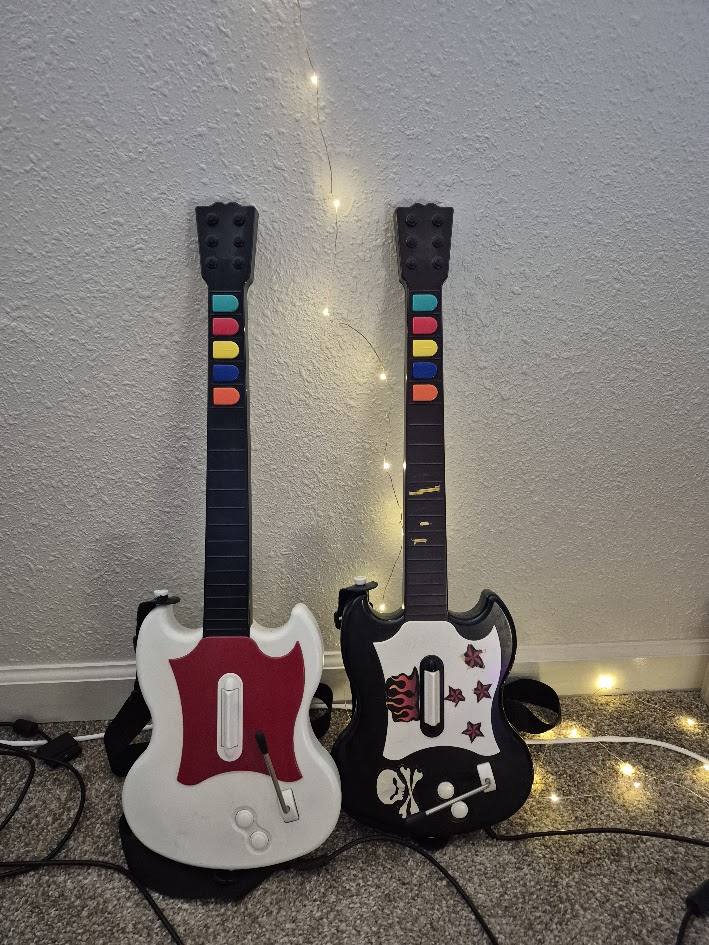
Rhythm games dominated the gaming world in the late 2000’s and impressively infiltrated mainstream pop culture in the process – and I loved every bit of it.
It’s always weird when the most unexpected event somehow leads to a new interest or chapter in life – especially when it’s so easy to always choose what you want to do and what you enjoy.
As a young kid, that feels like a pretty simple thing to do – find enjoyable ways to pass the time and make memories while maybe even developing some new talents and interests in the process.
I felt like my interests as a 10-year-old were pretty run-of-the-mill – I loved watching baseball, loved playing video games and had just begun to develop my own taste of music, coinciding with Green Day’s surge in popularity following the 2004 release of American Idiot.
On a random summer night in 2006, nothing seemed to be much different. I was playing video games as normal, and my younger sister (just under three years to my junior) was feeling a bit under the weather.
My dad had been out of the house to run some errands and called my younger sister on the way home, asking if she wanted a milkshake or anything else to help her feel better. My then-7-year-old sister, showing all of the personality she has to this day, instead asked for Guitar Hero.
Released less than a year earlier in November 2005, I was aware of Guitar Hero‘s existence by simply being plugged into what was happening in the gaming world and hearing some talk at school about what the game was like. I was curious and thought the game was cool, but I apparently wasn’t nearly as intrigued as my little sister.
My dad obliged and came home with the game, guitar controller and all – and I was instantly hooked, quite a bit more than my sister was. While she definitely enjoyed the game, Guitar Hero quickly became my favorite game, as I tried to make my way through the career mode on the lower difficulties in an effort to get better.
While I continued to play the game quite a bit over the next several months, the interest had turned into a true fixation upon the November 2006 release of Guitar Hero II, a sequel that featured a plethora of quality-of-life improvements to the first game.
Now armed with a second guitar controller and another full setlist, I felt that there was essentially an infinite amount of playing ahead of me between both games – with this being around the time that I started to get much better at the game.
By the time 5th grade was wrapping up for me in the spring of 2007, I had improved to playing Hard or Expert on most songs as the series began to gain more popularity and buzz ahead of the fall release of Guitar Hero III: Legends of Rock.
A big part of what drew me into Guitar Hero II so much in addition to everything it did better than its predecessor was its setlist – which not only served as a noticeable improvement from the first game, but also introduced to me to several artists that are an indelible part of the rock music canon.
While the majority of the songs themselves in Guitar Hero II were still poorly executed covers of the songs being played, that was more than enough to introduce me to several artists that I later greatly enjoyed. Nirvana was the most conspicuous example of this, with a bad cover of Heart-Shaped Box being enough to send me down a rabbit hole that began in earnest with buying In Utero from a Best Buy in April 2007.
During my discovery of new music through the series, many other gamers were getting acquainted to the titles for the first time. Beyond Guitar Hero kiosks being ubiquitous at retail stores during the late 2000’s, the game’s inevitable expansion brought it to a much larger audience than it had ever seen before.
While the first two Guitar Hero games were released as PlayStation 2 exclusives, the series took its first step into the new generation with an Xbox 360 port of Guitar Hero II, released in April 2007 with additional content and the ability to add more songs as downloadable content as well.
With 360 gamers now initiated on the series, the final tune-up to the momentous third installment of the series came in July 2007 with the release of Guitar Hero Encore: Rocks the 80s, a PlayStation 2 exclusive that felt much more like a Guitar Hero II expansion pack than it did its own game.
Nonetheless, it was still a new set of songs to hold myself over until the next game while the series was able to toss a bone to people who were still really into hair metal for some reason, like my mother.
The series transformed for good with the long-awaited release Guitar Hero III: Legends of Rock, marking a noticeable change in the games as Activision’s Neversoft division took over development from Harmonix and RedOctane, who were absorbed by MTV Games and Activision, respectively.
Beyond a refreshed user interface, a larger setlist and a vast expansion of customizable items, Guitar Hero III: Legends of Rock lived up to its grandiose reputation in every way. Beyond being the series’ debut for the PlayStation 3, Wii, PC and Mac, the game’s noticeable jump in difficulty from the previous two titles led to heightened attention towards its best players.
This was the most apparent with the inclusion of Through the Fire and Flames by Dragonforce, perhaps the most recognizable Guitar Hero song of all-time that was designed to be a gauntlet that would stop even the most proficient players in their tracks.
While the best of the best were able to master that song as much as any other one, the game’s hiked difficulty brought new life to bragging rights among casual players – as simply beating the game was as challenging as it had ever been.
By the time the third main installment of the series came out, Expert was my default difficulty, leaving me feeling that everything in Guitar Hero II would lead me prepared to blaze through this game. I was very wrong on that one.
The wildest thing about Guitar Hero III in hindsight as it served as the clear peak of the rhythm game phenomenon, being released around the same time as the first Rock Band game, while also including early signs of what would doom the series in just a few short years.
While the game’s difficulty initially served as a selling point and something to enhance casual gaming sessions, it eventually became clear that this game was simply too difficult for the casual player. I failed to beat the game on Expert during my original playthroughs of the game, finally returning to defeat 42/42 songs and the final battle with the Devil in August 2014, nearly seven years after I first picked the game up.
Although online play and loads of DLC for the Xbox 360 and PS3 versions helped keep Guitar Hero addicts fixated on the series, Rock Band introduced itself as a bona fide contender to the series – adding vocals, drums and bass guitar parts to each track to create a full band experience.
The response from the Guitar Hero series was to simply mimic their competitors, releasing Guitar Hero World Tour in October 2008 with a full band setup – but of course, the instrument peripherals are different and not compatible with one another.
It was at this time that I started to drift away from the Guitar Hero games. I had been deeply enamored with the Xbox 360 for quite some time, and my sister and I wanted to get in on the full-band experience. Having been burnt out on Guitar Hero due to its difficulty, it ended up being Rock Band 2 with the Xbox 360 as our Christmas gift, which solidified my shift away from the series.
Ultimately, Guitar Hero III would be the last game of the series I would receive new, with Green Day Rock Band, released in June 2010, marking the final rhythm game I got during its initial run.
The rhythm game phenomenon quickly died off by the early 2010’s, with the global financial crisis and oversaturation of the already expensive Guitar Hero and Rock Band games serving as the strongest contributors towards their demise.
While both series received a short-lived revival in 2015 on next-generation consoles with the releases of Guitar Hero: Live and Rock Band 4, poor sales led to both series entering another period of dormancy that continues to this day.
Today, myself and many other old legacy Guitar Hero players simply get our fix via our PCs with Clone Hero, allowing the possibility of playing thousands of different songs and charts that stretch far beyond what any console Guitar Hero game could offer.
Younger players may stumble across what was the cultural takeover of the Guitar Hero games thanks to Fortnite Festival, a rhythm game connected to the still vastly popular Fortnite. Yet it would be hard to truly convey just how big these games were.
I’ll always have fond memories of drawing crowds at a Best Buy while ripping Guitar Hero on Expert as a 10-year-old – a funny anecdote that perhaps perfectly sums up what made these games the cultural phenomenon that they were.
Sure, there had been Singstar, Dance Dance Revolution and Donkey Konga – but something about Guitar Hero made everybody stop what they were doing to see what was going on. From the amazing controller peripheral to dozens of recognizable songs and gameplay that required a different kind of skill than any title before it, Guitar Hero entered the scene as a unicorn, with magic that many games and developers tried and failed to replicate.
Maybe it was just because this was one of the few games I quickly got good at, or maybe it was because it was such a huge part in kickstarting my lifelong love of exploring new music. Either way, Guitar Hero will always be an integral part of my childhood. For something so damn simple, it played perhaps a bigger role than I often recognize in making me who I am today.
Leave a Reply