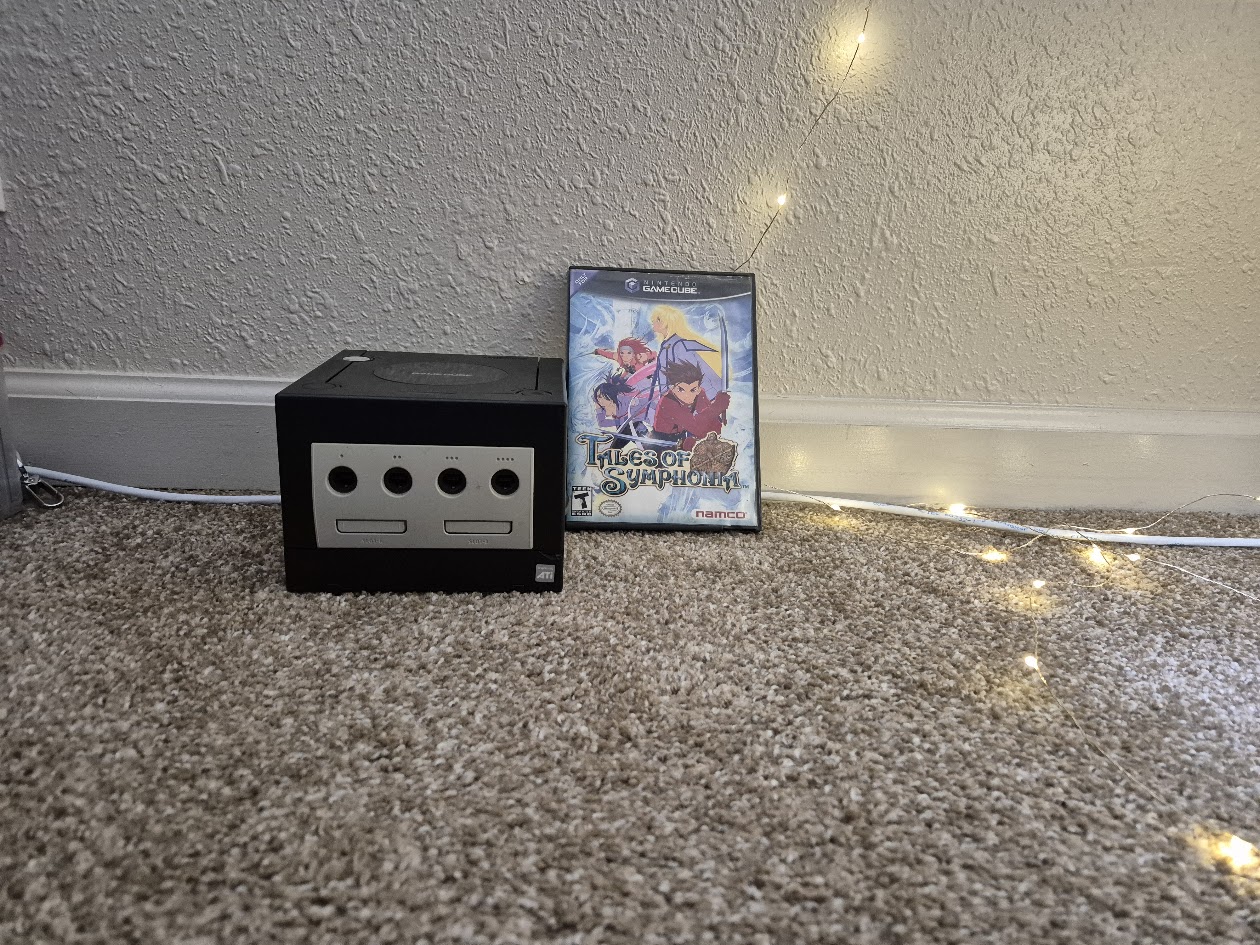
A continued look into how my favorite video game from my childhood greatly shaped my worldview and made me the person I became.
Note: While I will try to avoid major spoilers in this piece, I will discuss major plot points of Tales of Symphonia. Part 1 can be found here.
After learning of the existence of two worlds within the game and the hourglass-like relationship they share with one another, the party vows to go to Tethe’alla – a decision made easier by learning that the journey of world regeneration was a betrayal.
With the initial journey left technically incomplete, the two worlds maintained the same status they had – Sylvarant remained the waning world, while Tethe’alla continued to flourish.
This reality was made incredibly clear upon the party’s arrival in the new world, which served as the first taste of Tethe’alla for most of the party. The world’s largest city, Meltokio, laid bare the differences between the two worlds.
A densely populated, technologically advanced city that also served as the home of the world’s loyalty, Meltokio almost feels like a strange cross between Tokyo and London – with its Western European-influenced architecture and high emphasis extravagance.
While Meltokio served as the game’s introduction to many of the first-world amenities present in the game, it also exposes the player to the rampant inequality that comes with it – as Meltokio includes both a wealthy, royal neighborhood at the top of the city, as well as a shanty town that acts as arguably the most impoverished area in the entire game.
Especially in hindsight, this was a rapid difference from the towns and cities in Sylvarant, many of which had agrarian roots, more spread out populations and modest living accomodations.
Perhaps the most stark difference between the two worlds however is the presence of a caste system in Tethe’alla, a strictly enforced hierarchical system based on race.
Although race was mentioned sporadically while the party was in Sylvarant, it ultimately plays a pivotal role in the development of the game’s plot. While Lloyd, Colette, Sheena and the Tethe’alla newcomers to the party are all humans, Genis and his older sister Raine are both half-elves, the race that is placed squarely at the bottom of Tethe’alla’s caste system.
While discrimination was present in Sylvarant, the dynamic was significantly different. Raine and Genis had chosen to identify as pure-blooded elves to avoid the possibility of prejudice, while the Desians and Cruxis, the latter of whom served as the organization that carried out Colette’s regeneration ritual, were both comprised entirely of half-elves. Furthermore, several Desian leaders had espoused half-elf supremacist rhetoric towards the party, making the abrupt change in Tethe’alla feel even more sudden.
Being placed at the top of the caste system, humans had freedom of movement throughout the world, while pure-blooded elves were confined to the village of Heimdall, located in the middle of two expansive forests on the world’s southern continent. Half-elves, on the other hand, are required to stay in their locations of research and study and/or within the confines of their homes, with violation of the caste system punishable by death.
Despite being heavily discriminated against, half-elves were still relied upon in the worlds of science, technology and education in Tethe’alla, serving as the staff in both Meltokio’s Elemental Research Laboratory and the university town Sybak’s research centers.
The party confronted this reality head-on during their first visit to Sybak, which was made in an effort to cure Colette from the health effects she was still facing from the world regeneration journey. After being confronted by government guards in Sybak’s research center, Raine and Genis were DNA tested and confirmed to be half-elves. The two were promptly taken into custody to be escorted back to Meltokio for an execution, while the rest of the party was held in the building’s basement as punishment for traveling with half-elves.
While in the basement, Kate, the lead research scientist of the facility, was in disbelief that not only humans were traveling with half-elves, but that they were willing to risk their lives to save them.
I remember this being a watershed moment for me when playing through the game for the first time. Lloyd and Genis are introduced to the player as best friends from the very start of the game – comrades willing to defend each other from anything and everything. Of course Lloyd and the party would put it all on the line to save them – how would their race be even the slightest factor?
Yet Kate and the rest of the half-elves in the facility, raised in a world where their mere existence was designed to be questioned, believed that they were being duped by a group of humans who were merely trying to escape captivity.
After separating from the group upon their initial arrival in Meltokio to report her failed assassination of the Chosen, Sheena reappeared in the basement, explaining Lloyd and the party’s sincerity to Kate, ensuring their escape and effort to rescue Genis and Raine.
Voice of Sheena: …He isn’t from Tethe’alla.

Suddenly, Corrine appeared and released the arm bonding from Lloyd’s arms.
Then, Sheena also appeared at the scene.

Sheena: He’s a strange one who was raised in Sylvarant with half-elves and a dwarf.

Lloyd: Sheena! How did you know me…

Sheena: I’ll explain later. Genis and Raine are being taken to Meltokio. If we go after them now, we should be able to save them!

Kate: Are you planning on running away?

Sheena: Are you going to try to stop us?

Zelos: He’s going to save his half-elf best friend. What are you going to do, Miss Half-elf?

Kate: I…I won’t let you trick me. There’s no way a human would save a half-elf.
After convincing Kate, the party ultimately chases the guards down the Grand Tethe’alla Bridge connecting the continents of Sybak and Meltokio, defeating them and allowing Genis and Raine to rejoin the party.
From this point on, the discrimination of half-elves plays a central role to the game’s plot as Cruxis assumes the role of the game’s primary antagonists. An organization comprised almost entirely of half-elves, Cruxis appears to outwardly seek an age of half-elf dominance, while Yggdrassill, their leader, espouses a twisted interpretation of egalitarianism.
A central part to the plot of Tales of Symphonia that didn’t come up in the first part of this piece is the presence of exspheres.
Initially introduced to the player at the beginning of the game as an accessory that enhances strength, it is eventually revealed while the party is still in Sylvarant that exspheres are in fact the remnants of deceased life, with human ranches in Sylvarant ultimately acting as exsphere production facilities. Following periods of forced labor, captives at human ranches were killed and turned into exspheres as part of the process.
The life inside exspheres can also continue to exist until destroyed in the form of a “lifeless being” as the game calls it – a still sentient and present being contained entirely within the confines of an exsphere.
While many Cruxis leaders shouted “Glory to the coming age of half-elves” upon fatal defeat from Lloyd’s party, Yggdrassill reveals to Lloyd’s party in the end stages of the game that the version of equality he seeks is one where all life exists as lifeless beings – within exspheres, physically indistinguishable from one another.
A mindset that made as little sense to me as a kid as it does today, that clarity was unfortunately never reached by the right-wing voices in the real world who claim that racial and ethnic homogeny is the only way to create an egalitarian society.
Though this was already made clear to the player by Lloyd’s actions earlier in the game, the title’s main protagonist touts a more conventional definition of equality, all while never letting go of the sheer frustration and anger built up by simply seeing a world exist in this way in the first place. Oh, how we can all relate.
Lloyd patently lays out his idealism during the party’s first visit to Sheena’s hometown of Mizuho, a hidden forest village known for its secretive, traditionalist culture. After being asked by the village chief why Lloyd and his party traveled to Tethe’alla, the protagonist made it clear he did not seek to simply swing the pendulum back in Sylvarant’s favor.
"I’ve been thinking about that for a long time. Someone asked me why I
came all the way to Tethe’alla…what it is that I want to do. I want a world where everyone can have a normal life. I’m tired of people having to become sacrifices. I’m tired of discrimination. I’m tired of people becoming victims.I’m tired of it all."
While the rest of the game is a protracted struggle between Lloyd’s party and Cruxis as the group aims to reunite Sylvarant and Tethe’alla, I had heard all I needed to hear as a kid to think about how these kind of topics translate to the real world.
The quickest takeaway I got from this part of the game was simply thinking about the sheer level of discrimination against half-elves, simply for being who they were – something they were unable to change and did not choose. It had me thinking about just how pointless the discrimination was, and what the point of it all was, even within the confines of the game.
Outside of the game, it’s clear that discrimination is and has been rampant throughout human history, with Tales of Symphonia simply being one of literally countless works of art and media that draws from real-life examples of hardships.
Beneath it all though is the root of the worldview between the protagonist and antagonist of this game – while Yggdrassill strives for a twisted perception of what equality means while aiming to deprive everyone of life in an act of revenge, Lloyd and the party aim to give as many people as possible a safe, happy, healthy and stable life.
While this game is over 22 years old when considering its Japanese release, it’s hard to not draw parallels between the game’s themes and the global rightward shift of the past 15 years, which has seen xenophobia, nationalism and protectionism rapidly rise throughout the western world.
The 2020’s in particular have been incredibly brutal in this regard – a widespread anti-LGBTQ movement intent on erasing transgender people from public life, masked paramilitary thugs occupying American cities and a worsening crisis in the Middle East spearheaded by a devastating genocide and rampant collective punishment.
Very blatantly, there’s no actual gain to get out of any of these things, other than making peoples’ lives much worse. Yet even more obviously, there’s nothing to lose from letting transgender individuals live the lives they’re meant to live, nor is there anything to lose from letting immigrant communities continue to be indispensible parts of countless American cities.
Ultimately, the cruelty is the point – with many of the world’s most powerful leaders united by what can only be described as a desire to cause harm to large groups of people.
Only death, destruction, despair and anger are gained on the other side of wars, domestic occupations and discriminatory practices – when all of the effort used to carry out these actions could simply be directed towards improving education, public transportation, health care, infrastructure and renewable energy.
That’s ultimately the conclusion Tales of Symphonia left me with – that things really don’t have to be that complicated. Ultimately, people simply want to be happy, healthy and stable – it never made sense to me then and it especially can’t make sense to me now why so many powerful people devote their time, money and effort in life to prevent others from reaching those universal benchmarks.
The fact that Lloyd is portrayed as extremely dim-witted and relatively unintelligent across the board drives this point home in an even more poignant fashion. In an American society that lends so much attention to elite opinion columnists and pundits who are isolated from the average person, it serves as a necessary reminder of what so many of us want more than anything else – a nice life free of worry over basic necessities and armed conflict.
Even as a kid, I saw how much this simple, positive outlook was firmly at odds with the American Right, especially in a suburb like the one I grew up in. After years of hearing classmates express racist and homophobic sentiments on a near-daily basis, I often wondered to myself if simply playing this video game at a young age would have had the same impact.
That’s not to say I think I would have turned out to be some bigoted asshole if I never played ToS – I was lucky enough to be raised to treat everyone with respect and as a human, knowing that I never know someone’s full story. But for so many in my hometown and countless others across the U.S. and the world, those who are different are meant to be lampooned, made fun of, discriminated against and eventually ostracized from society.
I’m eternally glad I was exposed to these perspectives at such a young age, even if in the most unconventional of ways. Because it really is that simple. I’m tired of people becoming victims. I’m tired of discrimination. I’m tired of it all.
Game Script credit to Oliver Kong
Leave a Reply