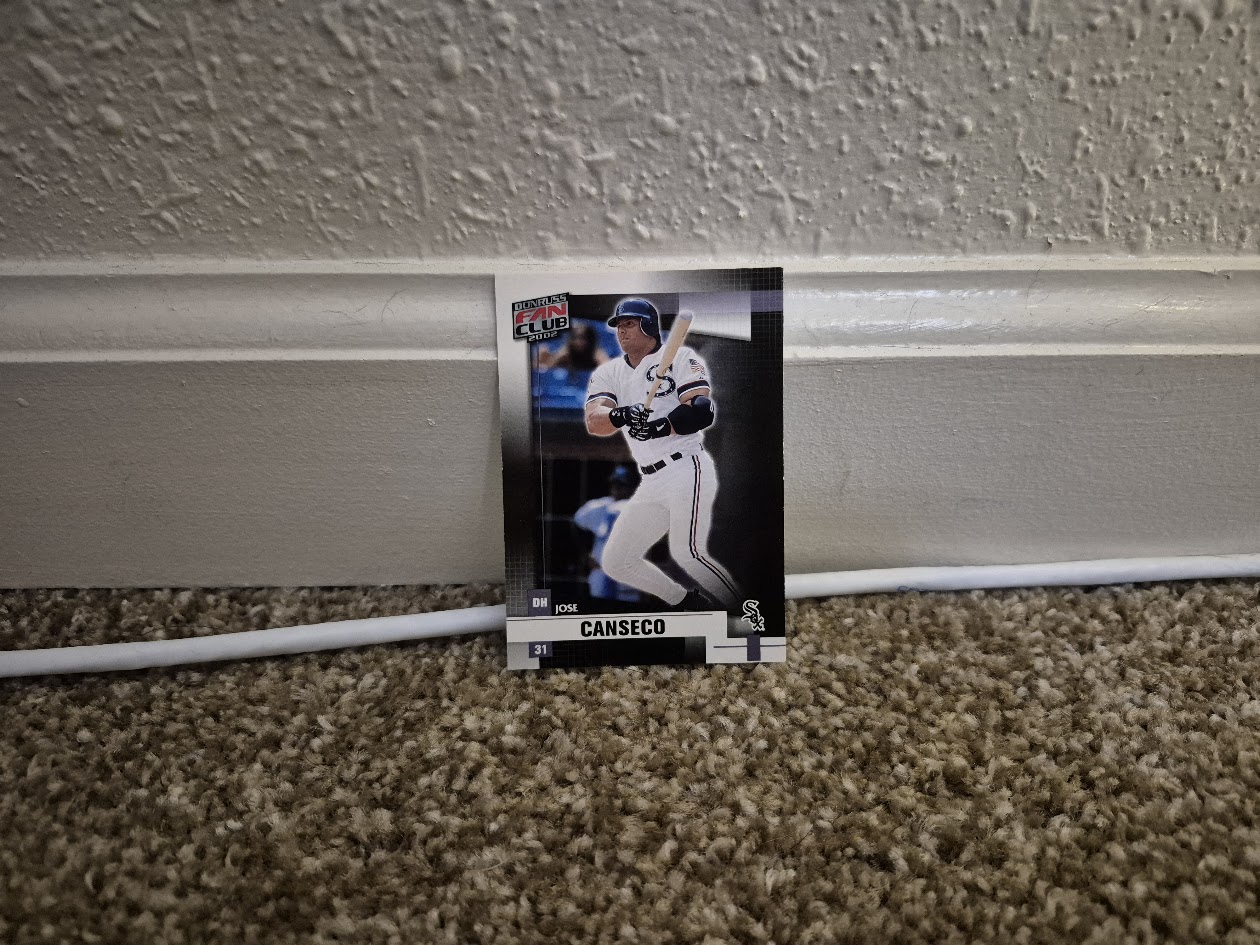
After an underwhelming second stint in Oakland, Canseco’s career saw a brief revival in the late 1990’s that was kickstarted by an incredible offensive campaign for Toronto that was widely overshadowed.
Say what you will about José Canseco, but there’s no arguing that he was never a guy to fly under the radar.
More than two decades after his playing days concluded in 2001, Canseco remains widely remembered in the baseball world and wider sports universe for a wide range of reasons. From his historic 40-40 MVP campaign in 1988 and status as one of the game’s premier sluggers to his tell-all tales of his playing days and performance-enhancing drug use, Canseco routinely made headlines during and after his playing career.
Which is certainly why it feels so weird to look at Canseco’s career and realize (or remember) that his career-high output as a home run hitter did not come in his historic MVP season, nor during the 1991 season that saw him lead all of baseball in long balls.
Instead, it was in his age-33 season, well into the back half of his career in his lone campaign with the Toronto Blue Jays in 1998.
Beneath the spectacle of Mark McGwire and Sammy Sosa chasing down Roger Maris’ single-season home run record while Ken Griffey Jr. handily led the American League, Canseco quietly hit a career-best 46 home runs for a Blue Jays team that finished just four games out of a playoff spot.
Canseco’s season with the Blue Jays looked to be a low-risk, high-reward move after his lackluster 1997 season with the Oakland Athletics in what was initially a highly-anticipated return to the club he made his name with.
Playing in 108 games, Canseco was worth just 0.2 WAR in 1997, putting up 23 home runs and 74 RBI with a .235/.325/.461/.786 slash line, amounting to a 106 OPS+ that tied his 1993 campaign for the worst mark in his career.
Canseco also wasn’t the juggernaut on the basepaths that he was earlier in his career, stealing just eight bases in 1997 while proving to be a defensive liability when playing the outfield.
As a Blue Jay in 1998, Canseco split time between designated hitter and the outfield, appearing in 78 games as the DH while playing 50 games in left field and another 26 contests in right field. While Toronto didn’t seem to get anything more defensively than the A’s did out of Canseco, it was not at all the same story when it came to his power and speed.
In addition to his career-high 46 home runs, Canseco posted 26 doubles and 107 RBI while putting up the second-highest stolen base total of his career, only trailing his 40-stolen base campaign in 1988. Though he was thrown out on the basepaths 17 times, Canseco notched 29 stolen bases to go with the incredible power production, certainly making up for his lackluster play defensively.
Home runs may have been historically easy to come by in 1998, but Canseco still proved he was worth his salt against many of the game’s finest pitchers. Canseco smacked home runs off of Randy Johnson, Pedro Martínez, John Smoltz, Andy Pettitte and Mike Mussina during the regular season, proving he wasn’t simply beating up on innings eaters.
Despite all the home runs, it’s not as if Canseco had suddenly returned to MVP form. In addition to poor defense, Canseco’s slash line of .237/.318/.518/.836 was unquestionably solid, but well below the levels of the league’s finest hitters in 1998 with an above-average OPS+ of 114. Canseco also led the junior circuit in strikeouts, back in a time where 159 strikeouts in a season could lead a league.
The overall picture behind Canseco’s numbers makes it add up as to why this season is one that’s often forgotten in the scope of his career, despite the career-best home run production. The 33-year-old slugger finished the season with 1.5 WAR while taking home the AL Silver Slugger Award for designated hitters, the fourth and final Silver Slugger of his career.
Canseco was also quite consistent across most major splits, slugging at a slightly higher rate at home while hitting for a marginally improved average away from Toronto’s SkyDome. There was also no major swing from first half to second half for the veteran, with Canseco posting a .528 slugging percentage in the first half and a .508 slugging percentage after the All-Star break.
The veteran slugger also posted rather interesting splits when it came to handedness – despite posting a .244 batting average against right-handers compared to a paltry .213 average versus southpaws, Canseco’s OPS against lefties was 60 points higher than his mark against right-handers, showing plenty of slug facing lefties. Still, 31 of Canseco’s 46 long balls were hit off of right-handed pitching.
Though not exactly a season to write home about relative to the best of 1998, Canseco’s impressive power production was also overshadowed within his own clubhouse, as the Blue Jays boasted an incredibly impressive lineup.
Carlos Delgado’s prime was fully underway with a 5.4 WAR season that included 38 home runs and a 151 OPS+, while lefty slugger Shawn Green managed 35 home runs and 35 stolen bases in an excellent 4 WAR campaign.
When including the pitching staff, Canseco finished 10th on the Blue Jays roster in WAR, finishing below pitchers Kelvim Escobar, Chris Carpenter, Woody Williams, Paul Quantrill and AL Cy Young Award winner Roger Clemens. Fellow position players Shannon Stewart and Tony Fernández also finished the season with a higher WAR than Canseco.
With Canseco’s production being heavily home run-focused, it would be easy to associate the strength of his 1998 campaign with his admitted and well-documented use of performance-enhancing drugs, but even Canseco himself would dispute that when it comes to this specific season.
Though Canseco has repeatedly admitted to using PEDs throughout most of his 17-year playing career, he insists that his 1998 campaign with the Blue Jays was among the times when he was not actively juicing.
In a 2012 interview with Sportsnet, Canseco claimed he stayed away from PEDs during his time in Toronto, attributing the abstinence to a divorce he was going through at the time, telling Sportsnet he didn’t want steroids to interfere with any breakup-induced depression.
Whether you want to take The Chemist for his word or not, his 1998 resurgence seemed to at least partially carry over into the next season as well. Canseco made his way to the expansion Tampa Bay Devil Rays for the 1999 season, which saw him compile 2.7 WAR with a .279/.369/.563/.931 slash line, amounting to a 134 OPS+ and his first All-Star appearance since 1992.
Canseco continued to post above-average offensive numbers over his final two seasons, splitting 2000 with Tampa Bay and the World Series champion New York Yankees before spending his final MLB season with the Chicago White Sox.
Though Canseco continued to hit in his final three seasons, the relatively complete offensive player the Blue Jays had in 1998 appeared to be a one-off anomaly. While Canseco swiped 29 bags in 1998, he would only steal seven more bases over the course of the final three seasons of his career. Though this was somewhat alleviated by an increased walk rate near the end of his career, Canseco was also striking out more after leaving Toronto as well.
In the time since the end of Canseco’s playing days, his career has been widely remembered by baseball fans and sports fans as a whole. His 1988 season showed new heights for the combination of power and speed as he solidified himself as one of the leaders of the last truly great A’s teams, while his unapologetic and emphatic stance regarding performance-enhancing drugs is seen as a hallmark of baseball’s steroid era.
Yet even with a player so widely known and followed throughout and after his playing days, there were still aspects that went forgotten or largely unnoticed beneath the backdrop of his larger-than-life persona. It’s just weird to think that one of the footnotes of his career is a 46-home run season in a one-year stint for a team most fans never remember him with. And that’s just baseball for you.
Leave a Reply