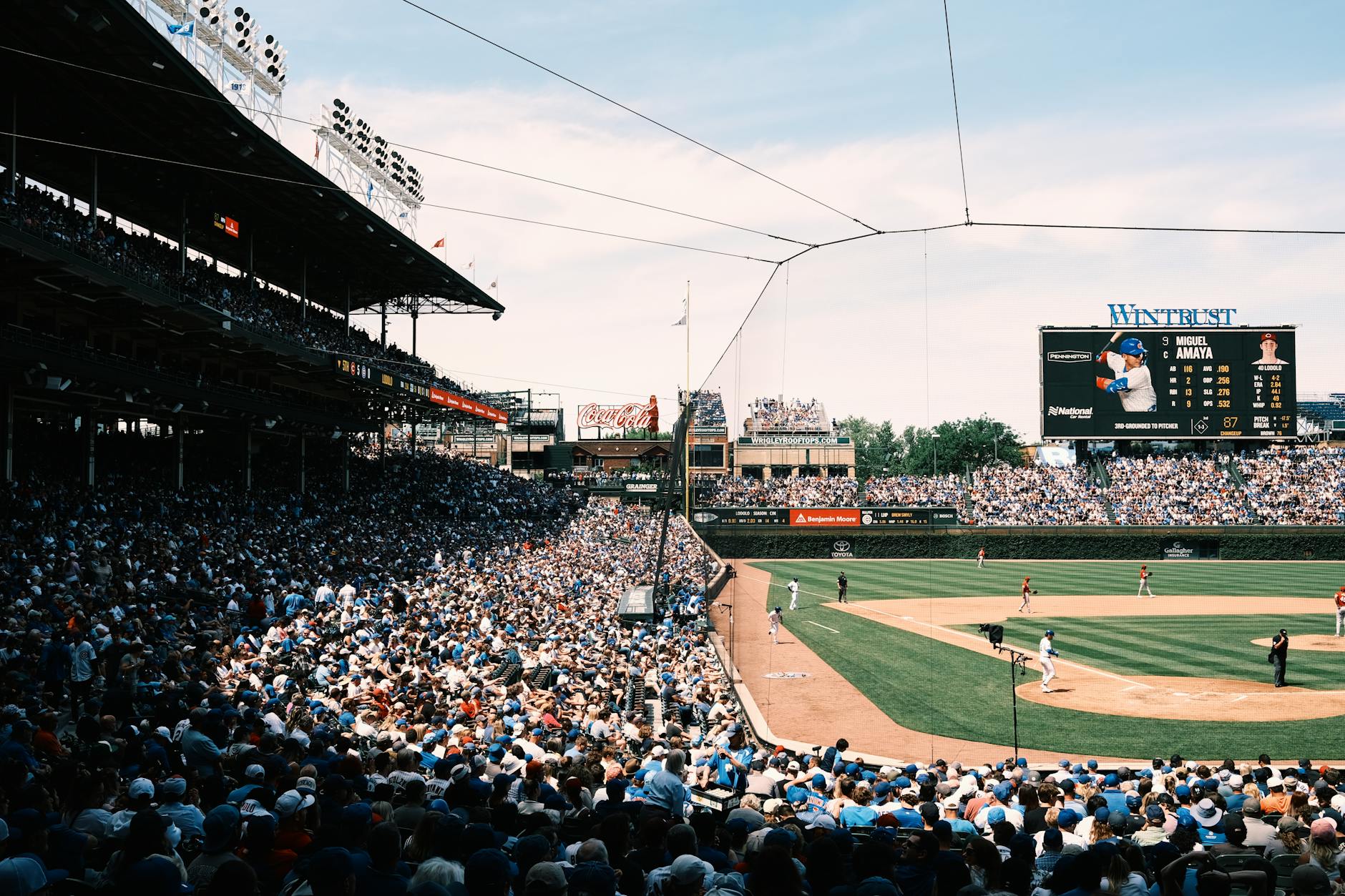
Entering play on Aug. 18 with a 98.3% chance to make the playoffs, the Cubs have also allowed 191 home runs – second to only the Athletics across MLB.
For a good chunk of Monday’s crosstown affair between the division-leading Chicago White Sox and Chicago Cubs at Wrigley Field, it looked as if the North Siders were on their way to one of their more frustrating losses of the season.
Despite outhitting the White Sox by an emphatic clip the entire evening and a strong start from Shota Imanaga, the one mistake made by the lefty resulted in three White Sox runs – with reliever Ryan Zeferjahn giving up a go-ahead home run in the eighth inning to give the ChiSox five runs on just three hits at the time.
The Cubs of course rallied back and captured one of their more riveting victories of the season, with NL MVP frontrunner Pete Crow-Armstrong leading the way. With two home runs, a double, walk, stolen base and single, PCA’s MLB-leading bWAR jumped from 7.3 to 7.7 as he turned in what was a textbook MVP performance.
But beyond PCA’s heroics lie a problem that has haunted this Cubs team throughout the season, and it’s a problem that very few MLB teams in recent memory have been able to overcome – they just give up way too many damn home runs.
In a sport that has evolved greatly over the past 25 years, home runs are an inescapable part of the game in a way that they haven’t always been. With pitchers throwing harder and nastier stuff than ever before, hitters across the league are selling out on doing their damage with slug – with extra emphasis going towards hitting the ball in the air and hitting the ball hard. Everyone is trying to hit a home run, and they’re simply bound to happen.
But that doesn’t offer a plausible excuse or explanation for the Cubs’ penchant for allowing the long ball this year – something that continues to be a problem even after cutting Jameson Taillon loose, who coughed up 25 home runs in just 76 innings of work.
Even taking Taillon out of the equation, the Cubs’ pitching staff is laden with arms that are prone to allowing the long ball. Shota Imanaga, long known for having a weakness for allowing home runs, has given up 29 tanks in 143.1 innings, while Colin Rea has served up 20 homers of his own.
Going further beyond Taillon, Imanaga and Rea, four other Cubs pitchers have allowed at least 10 home runs this year, with lefty reliever Caleb Thielbar sticking out as a sore spot out of the bullpen with 10 homers given up in only 37.1 innings.
If it feels like it’s generally hard for a team to succeed when they allow a ton of home runs, that’s because it is!
Since the 2000 season, only two teams that have finished the regular season in the top three of home runs allowed have even made the postseason – though both of those teams, the 2009 Philadelphia Phillies and 2010 New York Yankees, went on deep runs.
Both of those clubs also had very formidable, dangerous lineups as the Cubs do with numerous holes in their pitching corps that ultimately did them in in October. The Phillies in particular patched things up at the 2009 trade deadline by adding Cliff Lee to their rotation, but seasonlong struggles from J.A. Happ, Cole Hamels, Brad Lidge, Joe Blanton and Jamie Moyer led to the Phils giving up a whole lot of the long ball.
The 2010 Yankees were similar – beneath the ace-level performance of C.C. Sabathia was a patchwork of innings eaters with a propensity for pitching to the flyball, with A.J. Burnett, Phil Hughes and Javier Vázquez all allowing at least 25 home runs.
Outside of those two exceptions, the teams that lead the league in home runs allowed are typically among the worst in MLB. Attempting to compete for a championship with a team that allows more home runs than just about everyone else in today’s game feels like trying to win the NBA Finals while giving up more threes than any other team – it’s not just a major flaw, it’s one that is specifically exploited by the nature of the sport’s current metagame.
Of course, baseball is a very weird sport where expectations and precedents are meant to be defied. There are always outlier teams and players that seem to operate against the convention of how things usually play out, and the 2026 Cubs may very well be one of those teams.
But make no mistake – it is hard to win baseball games when you allow a lot of home runs, even if you get on base and hit plenty of them yourselves. While the Cubs have already allowed 191 home runs, the division-leading Milwaukee Brewers, who the Cubs are desperately trying to chase down in the NL Central, have yielded just 129 long balls.
While the Brewers have their own issue on their hands by hitting just 113 home runs, fewer than any other team in baseball, the club remains elite in just about every other statistical category – with Milwaukee’s pitching staff holding the best team ERA and ERA+ in the National League.
Unfortunately for the Cubs, their best chance at overcoming the plague of allowing the long ball is to avoid the best-of-three Wild Card series that they survived in 2025 against the San Diego Padres. While the Cubs allowed home runs at a clip above league average in 2025, the problem wasn’t nearly as obvious as it is with this year’s team – making survival in a short series where one swing can change everything a very difficult task.
Although the odds certainly aren’t in the Cubs’ favor, it’s not as if there isn’t an opportunity to chase down the Brewers in an effort to win the team’s first division title since the pandemic-shortened 2020 season. With seven games in the stretch of just 10 days against the Brewers at the start of September, Chicago will have their chance to work their way back into the division race – which would of course allow them to avoid a best-of-three series and advance directly to the NLDS, assuming that the Cubs would maintain one of the NL’s two best records.
As a lifelong Cubs fan, I hope I am wrong with my trepidation surrounding this team – which is one of the more fun Cubs teams I’ve gotten the chance to watch in my lifetime. The lineup is legitimately dangerous, the team has an excellent mix of young talent and veteran leadership and their strong performance has allowed rivalries to be reignited with some of the team’s more frequent opponents.
In a short series, one can throw out all of the regular season numbers about what a team can and cannot do – of course, this can benefit the Cubs, if they can stumble upon a two- or three-game stretch of not allowing the ball to leave the yard. But on the flip side, this mostly means that the Cubs shouldn’t fall into a false sense of security about a team’s lack of home run hitting, something that bit the North Siders in the ass during last year’s NLDS against the Brewers.
Despite the Diamondbacks and Padres being below league-average when it comes to hitting home runs, I wouldn’t want to see either of those teams in a best-of-three series, as both lineups contain several hitters that are more than capable of sending a ball out. When it comes to the Phillies, I don’t think an explanation is necessary – the Cubs know better than anyone else that you do not want to encounter Kyle Schwarber in October.
With all of this being said, it should be noted that the Cubs moved to improve upon this issue at the trade deadline. Jameson Taillon, the pitcher most prone to allowing home runs, was designated for assignment while the team acquired Kevin Gausman and Clay Holmes in trades – with both pitchers allowing home runs at a much slower clip than the rest of the Cubs’ staff.
Still, the North Siders will be heavily reliant upon a lineup that will inevitably slump at times to win slugfest games on the big stage, assuming the team holds on to their sizable NL Wild Card lead and makes the postseason.
In baseball, anything can happen. The 2026 Cubs easily have one of the best lineups in baseball, and it’s a lineup that is absolutely capable of winning a World Series.
But coupled with a pitching staff that is nearly guaranteed to give up a home run or two each evening, fans are left with a confusing ballclub that is just as capable of getting knocked out of the NL Wild Card Round as they are of winning the World Series.
Every team in every postseason has flaws. In 2026, the Cubs will have to confront a very conspicuous flaw down the stretch as the team looks to improve upon a five-game loss in the NLDS last season.
Leave a Reply