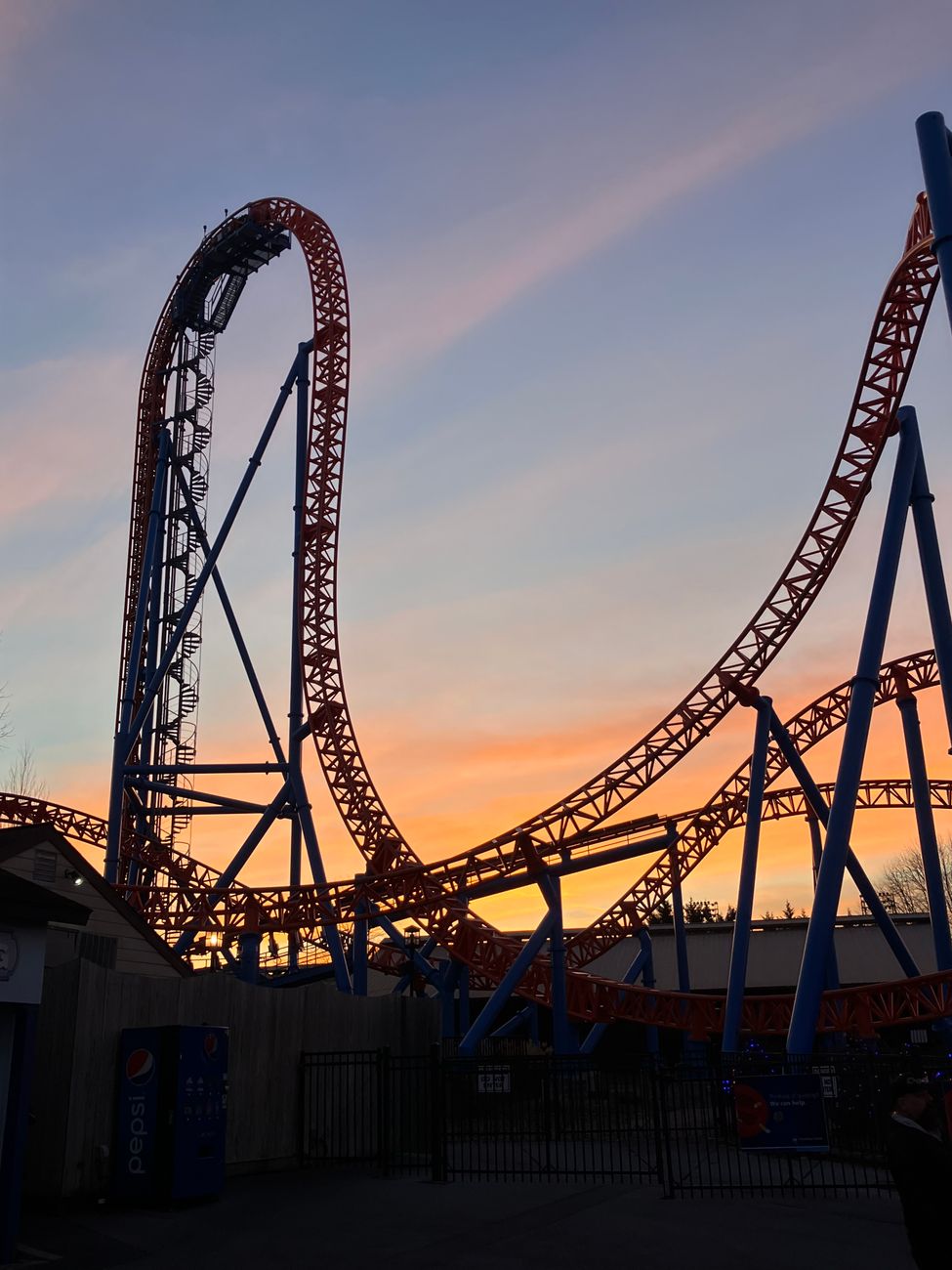
While most metropolitan areas in the U.S. have at least one large amusement park within reach, riding thrilling roller coasters necessitates a bit of travel for residents of a few cities.
When it comes to roller coasters, I never fully understood how spoiled much of the Midwest was while growing up, operating under the assumption in my head that a park like Six Flags Great America was within reach to people in most cities.
Ideally positioned in Gurnee, Ill., around halfway between Milwaukee and Chicago, the park serves as one of several high-octane Midwestern theme parks, with the state of Ohio supplying the other two heavy hitters with Cedar Point in Sandusky and Kings Island in Mason, the latter located not far outside Cincinnati.
Across the country, most large areas have at least one park with high-budget attractions to sneak in some summer thrills. The New York City and Philadelphia areas can likewise meet in between in Jackson, New Jersey at Six Flags Great Adventure, while Angelenos have Six Flags Magic Mountain and Knott’s Berry Farm within reach.
Even a good chunk of comparatively smaller areas aren’t left in the dark in this regard. Parks like Kennywood in the Pittsburgh area, Six Flags St. Louis and Worlds of Fun in Kansas City all have established reputations as summer hotspots in their regions, despite not having quite as large of an anchor metropolitan area that other parks do.
Still, a few regions across the United States act as roller coaster deserts, where your best bet to find yourself on an acclaimed coaster is to set aside a few days and hop on a plane to whichever park you’re most eager to check out.
While just about every city can support a theme park of at least moderate size, there were three regions that stuck out to me when looking at coaster density across the U.S. as areas where a respectably sized park has the opportunity to thrive.
Here’s a look at the areas that are in the most need of some roller coasters:
1. Seattle-Tacoma metropolitan area
In what has always been a puzzling fact to me, the Seattle-Tacoma metropolitan area has long been a roller coaster desert, with the closest thrills likely lying well to the east at Silverwood, nestled away in the forests of the Idaho panhandle in Athol.
Despite Seattle being the heart of a continually growing region that now boasts a popularity of nearly 4.15 million people, Six Flags and the now-defunct Cedar Fair have simply sat out on the area for as long as coasters have been a fixture of summer in America.
According to Roller Coaster Database, there are currently just 10 roller coasters in the entire state of Washington – the same amount that a parkgoer would find in a single visit to Knott’s Berry Farm.
This has always confused me quite a bit – in addition to the sheer size and population of the Seattle area, the climate offers a pretty favorable environment for coasters as well. While rain is common throughout the year, the region’s *usual* lack of oppressive heat and brutal winters offer potential for a lengthy operating season and comfortable riding temperatures for most visitors.
A park in the Seattle area would immediately fill a massive void felt by residents of the Pacific Northwest, and would likely be a significant draw for residents of the Vancouver and Portland regions as well.
2. Phoenix-Mesa metropolitan area
Both similar and radically different to the situation in Seattle, Phoenix is a continually growing and already massive metropolitan area that doesn’t have a large theme park across the region – although the reasons for that are perhaps a bit more obvious.
The extensive, deadly heat of the Phoenix area is no joke, and makes the marketing of any outdoor activity a tough sell when triple-digit temperatures are the norm from May through early October.
Yet the summer weather doesn’t change the fact that thrillseekers and enthusiasts in Arizona are left high and dry (no pun intended) when it comes to amusement parks and roller coasters, with there also being just 10 roller coasters throughout the entire state.
While a traditional amusement park may not be the best bet in the Phoenix area, the region does present a unique opportunity to perhaps explore what a hybrid indoor-and-outdoor theme park would look like – taking advantage of some air conditioning and comfort in the summer while capitalizing on the area’s pristine winter weather that routinely draws visitors from across North America.
Though most Phoenicians are now stuck having to either head to Southern California or Texas to catch some thrills, there is still an unoccupied lane available for a distinct park in the desert.
3. Detroit metropolitan area
Despite the Midwest being absolutely stacked with incredible large and smaller theme parks alike, the Detroit area has long been a noticeable omission to this phenomenon.
Although Detroit-area enthusiasts likely are just fine with the two-hour~ drive to Cedar Point, it’s fair to associate that park much more with the Cleveland and Toledo areas, of which Sandusky is located roughly in between.
While there is still Michigan’s Adventure located on the western side of the state in Muskegon, the park lies further away from the Detroit area than Cedar Point does – leaving Michigan’s Adventure to serve the Grand Rapids area much more than Detroit.
Though the distance between the area and a large park is nothing like it is in Phoenix and Seattle, the absence of a major theme park in southeast Michigan is still notable – especially considering Michigan’s branding and reputation as a summer tourism hotspot.
With plenty of options to provide a mix of high-octane thrills and quaint, natural beauty, a park in the Detroit area would fill a void while having the opportunity to carve out a distinct image as a park – even in the crowded Midwest.
Leave a Reply