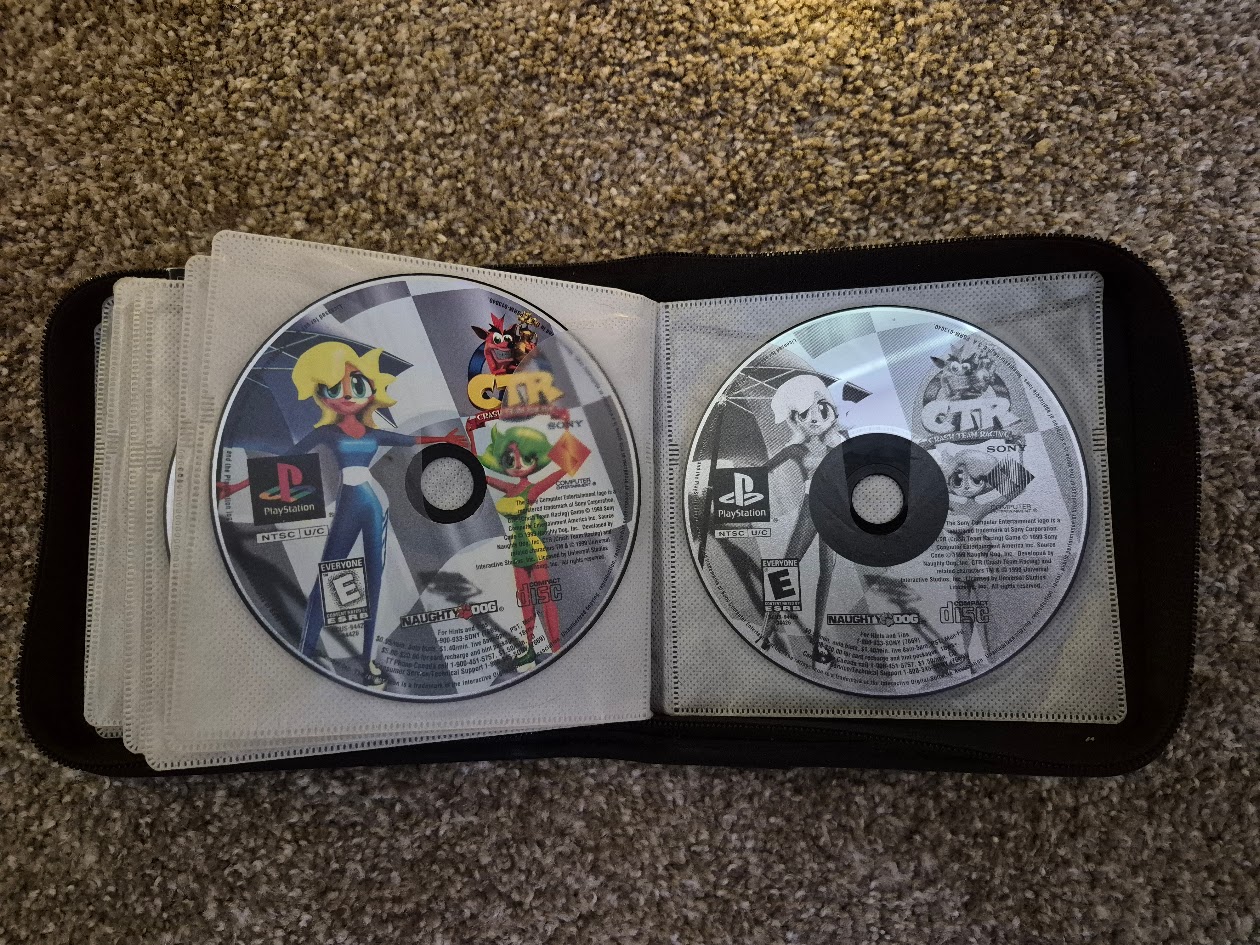
In what will likely be the final ranking involving the 1999 kart racer, I take a look at the feature that made Crash Team Racing what it was – the immersive hubworlds within the single-player story mode.
It’s certainly no mystery or secret at this point, but I grew up absolutely loving Crash Team Racing.
After initially getting introduced to video games as a toddler by way of Super Mario All-Stars on the SNES, my horizons were expanded after my family got a Sony PlayStation in the late 1990’s, a system originally purchased for my dad to play Test Drive 5, a conventional racing game released in 1998.
While my first taste of the Crash Bandicoot series came with the iconic Warped, an interest turned into an obsession and fixation after we ended up getting Crash Team Racing.
Although I loved every part of CTR, what truly drew me to the game was the inclusion of a dedicated single-player story mode, with boss races and 18 different tracks to navigate.
A central part of the single-player experience is navigating through the hubworlds, which each contain the courses and boss races necessary to continue in the game.
Though undoubtedly taking inspiration from the recent advent of the hubworld most prominently showcased with Princess Peach’s Castle in Super Mario 64, CTR gave the concept a fresh, novel twist. Navigating through the areas on a vehicle added a new element of exploration, while changing atmospheres and surroundings aid in indicating to players that they are progressing through the game.
I have essentially limitless nostalgia for this game, but the characteristic that always sends me back in time when thinking about this game has been the ambiance players take in when driving around the hubworlds.
So after already ranking the tracks and boss races within this game, I thought it would only make sense to go through and rank the hubworlds, bringing myself back in time to some of my earliest gaming memories while isolating exactly what it is about each world that I liked and continue to like the most.
This list will not take the courses within each hubworld into consideration, and will rather simply be a ranking of which hubs are the most enjoyable and fun to be in and drive around. In addition to graphics and surroundings in each of these areas, I’ll also take the music and layout into consideration.
5. Glacier Park

The third of the game’s five hubworlds, Glacier Park always stood out to me to be the least interesting thematically, with its snow-capped mountains taking inspiration from winter-themed levels in Crash Bandicoot 2: Cortex Strikes Back.
With winter themes not really being anything particularly novel, Glacier Park feels like the most forgettable of the hubworlds, likely due to the lack of Crash-specific characteristics that some of the other hubs provide.
Glacier Park’s strength is undoubtedly in its layout, serving as the game’s only hub with three entrances. This makes it the most central location of the five hubs and a solid starting point for navigating throughout the rest of the world in single-player mode.
While I certainly don’t have anything wrong with any of the hubs in this game, some use of this level’s topography could have made the world quite a bit more interesting, which would have opened up the possibility of courses being placed on top of mountains.
4. Gem Stone Valley

Technically the game’s fifth hubworld even though it’s just the second to be unlocked, Gem Stone Valley differs from the other hubs in that it does not contain four courses – instead including many of the loose ends that must be tied up at the end of the single-player mode.
Paying homage to the Crash series’ repeated inclusions of gems as collectables, Gem Stone Valley is surrounded by mountains and waterfalls while featuring entrances to both N. Sanity Beach and The Lost Ruins.
Though an aesthetically pleasing world, Gem Stone Valley feels conspicuously empty in some areas, with not too much of a theming or musical change from N. Sanity Beach, which is where players would have just came from.
3. Citadel City

The fourth and final of the primary hubworlds, Citadel City does an excellent job at making the player feel like they’re approaching the end. Surrounded by towering castles and village buildings that appear to take inspiration from the medieval-themed levels in Crash Bandicoot: Warped, Citadel City properly ups the ante in CTR.
Despite the old-timey feeling players are greeted with upon entering, Citadel City also incorporates a bit of futurism throughout, with the indoor areas featuring prominent stained glass portraits and a space station near Oxide Station, the final track of the 16 mainline courses in the game.
The atmosphere is further enhanced by a triumphant horn riff that takes over the familiar theme heard throughout the hubworlds, once again adding to the feeling of finality the world should have on the player.
Citadel City’s primary weakness comes in its layout, serving as the game’s only hubworld to only have one entrance and exit. Given the plot’s direction after completing this hubworld, having an entrance to Gem Stone Valley would have greatly enhanced navigation in both this level and the rest of the game.
2. N. Sanity Beach

Perhaps the most recognizable location in the entire Crash Bandicoot series, N. Sanity Beach makes another appearance in CTR as the game’s first hubworld.
Modeled after the previous iteration of the level seen in the original Crash Bandicoot, which in turn takes inspiration from Australian scenery, N. Sanity Beach is a picture-perfect start to the game.
In addition to a tropical twist to the game’s theme music, N. Sanity Beach is a familiar, easy-to-navigate world with two entrances and a layout that makes the level feel a good deal larger than it actually is.
This is also a world where the PS1’s background graphics get a chance to shine, with a serene cotton candy-like sky in the background only adding to the level’s idyllic atmosphere that instantly drew me in as a young kid.
1. The Lost Ruins

It’s very hard to try to think of another level in a PS1 game that more perfectly sums up the nostalgia and calmness that was possible to portray with the system’s simple graphics.
While loving everything else about CTR certainly helps, The Lost Ruins was the hubworld that truly drew me into the game as a kid. Inspired by the ruins-themed levels of the original Crash Bandicoot, The Lost Ruins creates a navigable, expanded version of the kind of environment first teased to players in levels like Sunset Vista and The Lost City.
Perhaps knowing it was hard for players to enjoy those levels due to their high difficulty, The Lost Ruins creates a perfectly tranquil environment, filled with more nooks and crannies than any of the hubworlds to allow for at least a little bit of exploration.
The level’s music is the perfect finishing touch for what is always a pleasant visit when playing through the game, with a more percussive rendition of the title’s theme with a flavor of world music.
In many ways, The Lost Ruins is a perfect encapsulation of everything that makes CTR a timeless game – a unique layout, intoxicating theme music and a pristine environment rife with turn of the century nostalgia. At least for me, it’s pretty hard to top that.
Leave a Reply