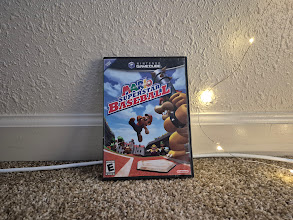
One of many Mario sports spin-offs, this 2005 release for the GameCube remains a highlight in the franchise.
I know I’ve certainly made it no secret in my writings on this site, but at all stages of my life, sports and video games have been my two most prevalent interests.
Getting exposed to the Super Mario series and Chicago Cubs baseball in the earliest moments of my life, I quickly became a sports-obsessed gamer, rotating my hobbies between watching summers full of baseball while also dedicating hours to my favorite games.
Though my interest in gaming went a few different directions in my childhood years, playing Mario games always felt like coming home in a sense, as those were the first games I was ever introduced to.
So when I heard about the upcoming release of a Mario-themed baseball game as a 9-year-old in 2005, my interest was immediately piqued. Sure, I had played licensed MLB games like Triple Play 2001 and MLB 2004 before, but to bring all of the characters I recognize from the Mario series onto the diamond felt like a game specifically made for me.
After a bit of lobbying to my dad, I got a copy of the game on the night it came out in August 2005, following a long, fruitless visit to the now-defunct TigerDirect, a perenially slow electronics store that was infamous for the long waits imposed on customers.
Despite it being a school night, I remember getting home just in time to try the game out, with my first impression leaving me instantly enamored. In the weeks, months, years and decades to follow, I still have not gotten tired of this game.
What still keeps me gravitated towards this game all these years later is how impressively faithful it is to the spirit of baseball while still implementing fun, kid-friendly gimmicks that maintain the integrity of the Mario series.
Pitchers have the option to throw fastballs and changeups while also having the ability to change a pitch’s direction near the plate on slower pitches. While on the mound, players also have the freedom to move horizontally, giving more options for different angles to throw pitches at.
The frivolity of the Mario series is kept in place thanks to the inclusion of Special pitches and hits, which implement a themed boost of sorts to make for a much larger chance of success on a given pitch or swing.
For example, Mario and Luigi are able to both throw and hit fireballs, which travel at a significantly faster speed than other pitches and are therefore incredibly difficult to both hit and safely field. Conversely, Donkey Kong’s special is the Banana Ball, which sends both pitches and hits on a swirling, almost boomerang-like trajectory that make it very difficult to track on both ends of the field.
These inclusions are given even more meaning in the game’s single-player mode, which is what truly sets Mario Superstar Baseball apart from the other Mario sports spin-offs seen over the years.
Instead of being limited to quickplay games against CPUs, Mario Superstar Baseball offers a full-fledged campaign mode with four separate difficulties, with the player needing to choose a team captain and recruit players from other teams en route to facing Bowser’s team at the end of the journey.
In the single-player mode, players can choose from Mario, Peach, Donkey Kong, Yoshi and Wario to be their team captain, with Bowser becoming an option after defeating the game on all four available modes (Mushroom, Flower, Star and Special).
In addition to recruiting characters and captains from other teams before playing against Bowser, players are also able to improve each individual character in the game thanks to Star Missions. Upon the completion of each one of a character’s Star Missions, that character then reaches “Superstar” status, increasing all of their attributes and making them a more formidable player going forward.
While some minor characters like Goomba or Shy Guy only require four completed Star Missions to make them a Superstar, team captains and sub-captains such as Mario, Yoshi, Daisy and Birdo require up to 10 completed missions to become Superstars.
Needless to say, with four different difficulties, a large cast of characters and a range of objectives, Mario Superstar Baseball‘s single-player mode offers an incredible amount of replay value – enough to still have me aiming to make every character a Superstar nearly 21 years after the game’s release.
Beyond the sheer immersiveness of the single-player mode and addictive nature of multiplayer games with friends, Mario Superstar Baseball remains surprisingly faithful to baseball itself, with players forced to make numerous strategic decisions throughout the course of the game that make a kids-themed baseball game feel unusually similar to the real deal.
Much of this begins with the different attributes each character has, with the game’s characters split into four categories: Balance, Technique, Speed and Power. While Balance includes solid all-around players capable of doing it all at a decent level such as Mario, Luigi and Birdo, other characters have distinct specialties that players must learn to utilize.
While the Technique character Waluigi is known to be a poor fielder with limited range and a contact hitter with little power, he is also perhaps the best pitcher in the game – his lanky figure and propensity for throwing offspeed pitches as a left-hander make opponents feel like they’re facing a combination of Clayton Kershaw and Randy Johnson.
On the other end, Petey Piranha’s incredible coverage from the left side of the plate along with his sheer size and power makes him perhaps the most-feared hitter in the game, with his ability to both draw walks and hit absolute moonshots making him feel like the Barry Bonds of Mario Superstar Baseball.
Ultimately, baseball fans can identify player comparisons on their own as they play through more of the game, making it all the more fun for gamers like me who are equally into baseball. Never did I think I could compare Yoshi and 2007 Jimmy Rollins before playing this game, which continues to be a standout title for the GameCube all these years later.
What also helps keep this game’s legacy intact is unfortunate on many fronts – the fact that this game still hasn’t received a worthwhile sequel. While Mario Super Sluggers was released as the follow-up to Mario Superstar Baseball for the Wii in August 2008, the game was widely viewed by many, myself included, to be a significant step back.
Although the addictive single-player mode was kept in place, the game’s controls, graphics and lack of online play were all major drawbacks, with motion controls not offering a fitting replacement for the very ideal GameCube controller. Additionally, players are unable to move freely in the batter’s box in Super Sluggers, significantly limiting the player’s options when it comes to plate positioning.
In the 18 years since the release of Mario Super Sluggers, Nintendo has completely ignored baseball despite continuing to add titles to other Mario sports series, including Mario Golf, Mario Tennis and Mario Strikers. While I’d even be satisfied with just a modern remaster of Mario Superstar Baseball, we haven’t even gotten that yet.
While Mario Superstar Baseball wasn’t anywhere near the multiplayer blockbuster that earlier GameCube games such as Mario Kart: Double Dash!! and Super Smash Bros. Melee, the game still performed quite well commercially and has inspired a dedicated cult following since.
Despite being released just over a year before the Nintendo Wii hit store shelves in November 2006, Mario Superstar Baseball still sold over 1 million copies worldwide, making it the 36th-best selling game for the GameCube.
Although the game doesn’t feature the streamlined netplay setup and massive online and competitive community that a game like Melee does, YouTube channels such as Dinger City have showcased what competitive play of the game looks like while maintaining a small online player base.
While it seems like I can only dream, a modern take of this game today would make me just about as excited as I could possibly get for a new video game coming out. With so many more elements and characters to choose from, Nintendo truly could make a fitting, grand follow-up to the baseball series after a nearly two-decade hiatus.
Until then, I’ll just keep enjoying the same game I have since 2005 – one that remains my favorite baseball video game of all-time.
Leave a Reply