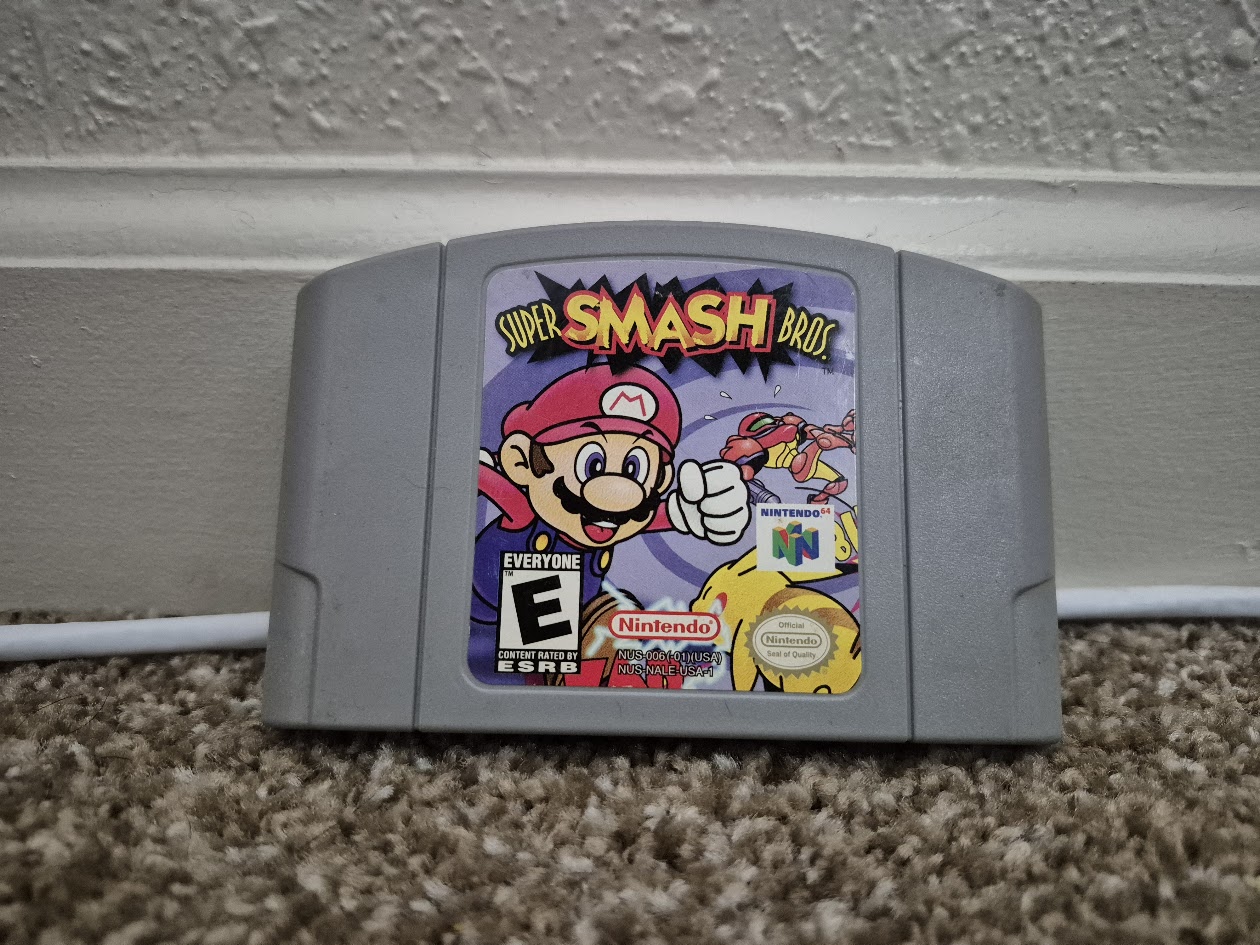
Originally released in 1999 for the Nintendo 64, the first installment of the Super Smash Bros. series features just 12 playable characters and nine stages.
After a total of six games and 27 years, it’s hard to believe that a gaming mainstay such as the Super Smash Bros. came from such innocuous beginnings.
What began as a party game released at the turn of the century blossomed into one of Nintendo’s most popular series, earning a new title on each home console that followed the Nintedo 64 while sparking a grassroots competitive scene connected to each of the series’ games that continues to this day.
While today’s competitive scene primarily revolves around the GameCube’s Super Smash Bros. Melee, released in 2001, and the Switch’s Super Smash Bros. Ultimate, released in 2018, the series got its start on the Nintendo 64 in 1999.
Building off the multiplayer legacy fellow N64 titles like GoldenEye 007, Diddy Kong Racing and Mario Kart 64 helped develop, Super Smash Bros.put essentially all of Nintendo’s biggest names in one place for the first time.
Fans of newer Smash games are likely used to the extensive catalogues that are the character selection and stage selection menus, but the series had a much more basic beginning. The original game offered a total of 12 playable characters, only eight of which were available from the start of the game.
Additionally, the game offered eight playable stages to start, with one additional unlockable stage also available. To help complete the atmosphere of Super Smash Bros. being a true crossover game, the eight starter stages all correspond with a starter character. In addition to being a flat-out fun game, there’s no doubt that the Smash series, from its very beginning, helped introduce gamers to other Nintendo games.
While I’m personally biased towards Melee, which has long been my favorite game of the series, Smash 64 was still the first game of the series I ever played, first getting the game not long after I received a Nintendo 64 for my fifth birthday in April 2001.
Serving as my first introduction to many of the non-Mario and Pokemon characters in the game, the stages played an integral role in setting a unique scene that matched each character.
Nearly 27 years after the game’s North American release, here’s a look at how I’d rank the game’s nine playable stages, based on a variety of factors.
Although my personal opinion and experience with the game is of course considered, I tried to most heavily factor in which stages were the best for casual multiplayer play, with the hazards on some stages working against their favor.
9. Saffron City (Pikachu)

The game’s Pokemon-inspired stage, Saffron City does a great job at setting the scene for those familiar with the Pokemon series – but does little else in terms of creating an atmosphere for an even fight.
The stage’s relatively small size and narrow, spaced-out platforms give a noticeable advantage to characters with more air mobility such as Kirby, Jigglypuff and Pikachu, while the box in the center of the stage produces Pokemon at random that create a significant hazard for all players.
This is most apparent when an Electrode Pokemon spawns, usually resulting in a quick death for any players nearby.
Ultimately, players are forced to fight on the larger platform in the center for most combat, making this a stage with much more risk than reward for most casual players.
8. Planet Zebes (Samus)

Another stage that does an excellent job thematically, players are placed on a dark, somewhat Battlefield-like stage that hovers over a rising and falling pool of lava.
The lava acts as the predominant and constant hazard on the stage, with characters taking significant damage when falling into the lava before, which simultaneously makes downward vertical kills quite difficult on this stage.
Planet Zebes certainly offers more fighting room than Saffron City does, but it feels quite difficult to play this stage and to not have the lava dominate at some point.
7. Hyrule Castle (Link)

My favorite stage in the game to play as a kid, Hyrule Castle has certainly soured on me over the years, owing to its large, disjointed size and intermittent tornado hazard.
The stage features three main sections – a slanted rooftop on the left, a larger center stage with a three-platform tower, and a flat platform on the right with a tent that is known to be a combo-starter for more experienced players.
In addition to the three sections, tornadoes intermittently appear on the map, which can easily kill those near it at a fairly low percentage. Although the stage’s size certainly represents an improvement over the previous two maps, the damage farm that is the tent on the right side of the stage and the aforementioned tornadoes make other stages less frustrating to play.
6. Sector Z (Fox)

Modeled after the spaceships seen in the Star Fox series, Sector Z is one of the stronger stages in the game thematically, placing players in a dark environment on Fox’s spaceship, with lasers from nearby Arwing aircrafts occasionally striking the players on the stage.
One of the larger stages in the game, the map features a long, angled main platform with a steep drop-off to the second part of the stage, a small landing area on the ship’s tail.
The stage’s large size makes vertical kills easier to accomplish in most parts of the map, though the tail area offers great potential for combos by making use of the spaceship’s wall, not unlike the tent’s combo potential in Hyrule Castle.
Undoubtedly a fun stage that perfectly adheres to its theme, Sector Z drops off on my rankings due to the hazards presented by Arwing lasers and the combo-heavy lower area on the stage’s right side.
5. Mushroom Kingdom (Unlockable)
#/media/File:MushroomKingdom64.jpg)
The game’s lone unlockable stage, players are able to access this level after completing 1-Player mode with all eight starter characters and playing the other eight stages on versus mode.
Perhaps my favorite stage in the game from a thematic standpoint, Mushroom Kingdom puts players in an area that mimicks the end of an NES Super Mario Bros. level, including the iconic staircase, flagpole and fortress associated with the game.
While a relatively small stage, players are also given the option to travel to opposite ends of the stage using two green pipes, which also include Piranha Plant hazards if you’re not able to get down one of them in time.
Undoubtedly a fun and aesthetically pleasing stage, Mushroom Kingdom’s small size and gaping hole in the center of the stage can lead to quick deaths, with the Piranha Plant hazard often providing just another obstacle to the fighting.
4. Peach’s Castle (Mario)

The default Super Mario-themed stage of the game, this level takes inspiration from Super Mario 64, displaying the facade of Princess Peach’s Castle in the background of what is a small, sky-based stage.
Featuring a small center stage with a longer platform above it and a landing area that shifts from left-to-right beneath, players are somewhat kept within the stage’s boundaries thanks to two ramp fixtures at the top left and top right corners of the level, with a floating bumper directly above the center of the stage for good measure.
Unlike many of the preceding stages, there aren’t really too many hazards in this stage, though players may take a funny bounce off of the floating bumper.
This stage is kept from being one of the game’s best due to its small size making battles with more than two players quite overwhelming, in addition to the stage’s ledges being ungrabbable, making a fall of the stage particularly perilous for characters without a strong air-based recovery.
3. Yoshi’s Island (Yoshi)

I suppose one shouldn’t be too surprised that my top three stages were the three stages from this game that were also carried into over Melee, but I’d like to think the developers just knew when they struck gold.
Themed after the N64 title Yoshi’s Story, Yoshi’s Island puts players on a hazard-free, platform-based stage set in a happy environment ahead of creamsicle-colored skies, perfectly matching the aesthetic presented in the original game.
Featuring a slightly slanted main platform that folds in towards the middle, players have access to three platforms above the main stage, with the bottom two platforms sloping inward while the top platform above the center of the main stage is flat.
The stage also includes cloud islands to the left and right of the stage – which provide both an aid or a hazard, depending on what character you’re playing.
While you won’t catch any strays from mysterious Pokemon or spaceship lasers, the spacing of the clouds and height of the stage’s platforms make the level heavily favor characters with high jumps such as Kirby, Jigglypuff and Yoshi.
2. Congo Jungle (Donkey Kong)
The game’s Donkey Kong-inspired stage, this level perhaps offered a bit of preview of what was coming for fans of the series, with the highly-acclaimed Donkey Kong 64 coming out in North America just seven months after the release of Super Smash Bros.
Putting players on a sloped wooden stage in a jungle sunset atmosphere, the level also includes two small rotating platforms in addition to two higher-up stationary platforms, the latter of which provide an ideal camping spot for characters with higher jumps.
The stage also includes a rotating DK barrel beneath the stage, which can come to a player’s rescue if they happen to fall of the stage directly into the barrel, which oftentimes catapults the player back up to the surface.
A very fun stage with a great ambiance and few hazards, this level misses out on the top spot due to the comparative ease high jumpers have in the map, which can lead to a slower, more stagnant pace of play.
1. Dream Land (Kirby)

Seemingly an obvious pick, Dream Land is the only stage in the game that is still allowed in competitive play, with the stage remaining one of the most recognizable of the entire series as it has been included in five of the six titles of the series.
Set in Kirby’s Dream Land, the stage features a flat main surface on a forested island in the sky, with three platforms above the main surface situated in a Battlefield-like layout. A true neutral stage, the level’s lone hazard are the wind-blowing trees, which can sometimes impact recovery and timing depending on what part of the level characters are at.
A moderately-sized stage relative to the rest of the game, discernible advantages from certain characters are effectively wiped out on Dream Land, with platform camping generally not seen as a viable option on this stage.
While players who are looking for a bit more going on with their levels may find Dream Land to be uninspired and boring, it provides the best atmosphere for pure fighting – which at least to me, is what the series has always been about.
Leave a Reply