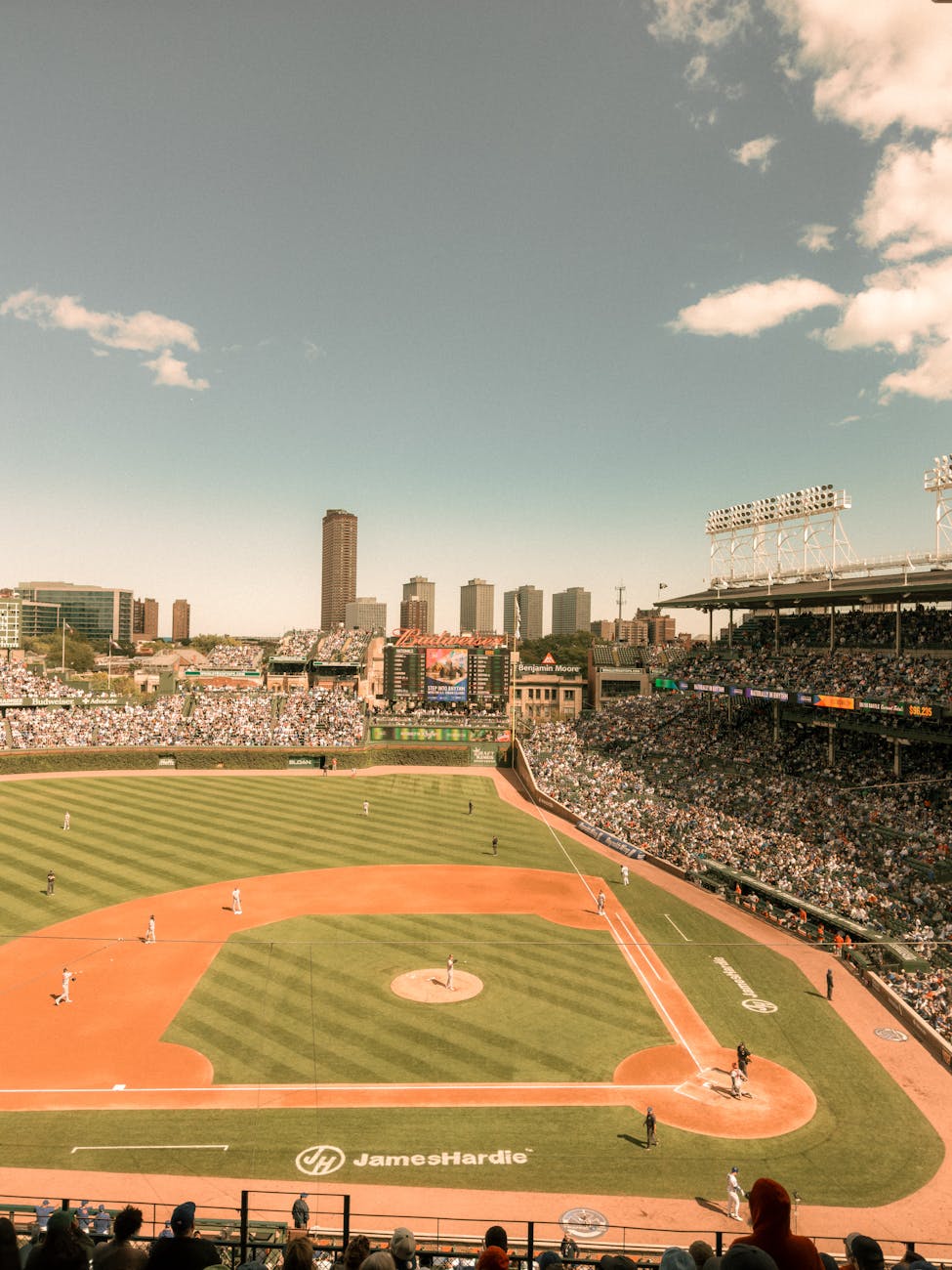
As rumors continue to float during a quiet offseason on Chicago’s North Side, a move of the team’s star second baseman would both upset fans and set the Cubs back competitively.
For an offseason packed with top-dollar free agents such as Kyle Tucker, Bo Bichette and Alex Bregman, things have remained relatively quiet on the free agent market as the new year has begun, with the Chicago Cubs among the many teams staying quite passive to start.
While the top pitcher on the market in Dylan Cease has signed a multi-year blockbuster deal with the Toronto Blue Jays and other prized free agents such as Pete Alonso, Munetaka Murakami and Kyle Schwarber have come off the board, there has yet to be an earth-shattering signing or trade this offseason.
Despite the Cubs’ status as a big-market team, it’s clear that the North Siders’ front office can’t exactly be expected to spend. Since shelling out $184 million on an eight-year deal to Jason Heyward ahead of the 2016 season, the Cubs have been rather gunshy on the free agency market, only approaching that total once with the seven-year, $177 million contract Dansby Swanson agreed to before the 2023 season.
This has made the Cubs a popular team to be floated in trade rumors, understandably enough after the team swung significant trades in the last two offseasons, nabbing Kyle Tucker from the Houston Astros last winter while swinging a prospect-heavy deal to acquire Michael Busch from the Los Angeles Dodgers ahead of the 2024 season.
A playoff team that was a game shy of the National League Championship Series in 2025, the Cubs’ needs are quite clear with the offseason beginning to wind down, especially after shoring up the bullpen with the Cubs-like, relatively low-dollar additions of Hoby Milner, Phil Maton, Jacob Webb and Hunter Harvey.
This means the Cubs bullpen is likely fairly close to being set for the upcoming season, though it’s clear that another high-velocity arm in addition to Daniel Palencia would help keep the North Siders competitive in a league where seemingly every bullpen is stacked with multiple flamethrowers.
With that said, the rumored focus has primarily centered around an addition to the rotation, one that has entered the spotlight even more after the Houston Astros lured Tatsuya Imai to Space City with a six-year deal worth $150 million.
Although Framber Valdez, Zac Gallen and Ranger Suarez all remain on the free agency market, the Cubs hesitancy to pursue high-dollar targets has led many to believe an addition would be sought via trade instead.
This has led Nico Hoerner’s name to pop up rather frequently in rumors, with the soon-to-be 29-year-old second baseman entering the final season of a three-year extension that took effect before 2024. Coming off a 6.2 bWAR campaign that saw him win his second Gold Glove award and finish 19th in NL MVP voting, it’s understandable that teams across the league would do their due diligence on a player of Hoerner’s caliber becoming available.
Yet pulling the trigger on a trade of Hoerner instead of outright pursuing every possible avenue to extend him would be an outright disaster for the Cubs. Perhaps the lone exception is the essentially nonexistent scenario where trading Nico Hoerner lands the Cubs a single year of Tarik Skubal, who then would have to lead the Cubs to a World Series title in his lone season with the team – can’t say I see that happening.
What the Cubs do have in Nico Hoerner is perhaps their most complete player, a role he’s largely lived up to over the course of the past two seasons. In addition to being one of the game’s elite second baseman, he also remains an excellent glove at shortstop whenever needed, all while standing out as one of the sport’s elite contact hitters.
An incredibly difficult hitter to strike out who is also a menace on the basepaths, stealing 103 bases over the past three seasons, Hoerner also proved to be an incredibly clutch hitter in 2025 for the Cubs. With a .371/.424/.457/.881 slash line with runners in scoring position, Hoerner consistently kept the line moving for a Cubs offense that had plenty of ups and downs as a unit throughout the season.
Most scenarios of the Cubs trading Hoerner involve the solution being to place 2025’s everyday third baseman in Matt Shaw at second base ahead of his second season in the big leagues. While Shaw dazzled defensively at the hot corner in his rookie season, he also didn’t exactly show signs of being the offensive superstar teams typically aim to have at third base.
In 126 games, Shaw hit .226/.295/.394/.690, good for a 98 OPS+ alongside 13 home runs and 21 doubles. While there’s certainly plenty of offensive upside here, Shaw’s 94 strikeouts in 393 at-bats make him nowhere near the contact stalwart that Hoerner is, removing a unique catalyst from the lineup.
This of course isn’t even to mention the inherent distraction Shaw will now bring with him into the upcoming season, one he ensured by appearing at a white nationalist pep rally under the guise of faith – all while one of his teammates was helping feed Chicagoans during the holidays.
If anything, this should make the Cubs much more eager to entertain a trade for Shaw, a young, promising player who is already close to being an elite defender at one of the game’s most demanding positions.
Yet trading Matt Shaw instead of Nico Hoerner would require the Cubs’ front office to do something they have outright refused to do over the past decade – open up the checkbook and pay a star player, this time in the form of Alex Bregman, a clear fit for the Cubs at the position.
It would have to take a lot of blue Kool-Aid for me to be convinced the Cubs would actually seriously pursue Bregman and put up a competitive offer, which is why the Cubs are perhaps only conveniently listed as a team “interested” in many of the sport’s top free agents.
Beyond the Cubs seeing Alex Bregman as too much of a high-dollar player to sign, which has been and is quite obvious, the more stunning revelation would be that the Cubs view Nico Hoerner as too much of an expense – a pathetic conclusion to reach if that’s truly the case.
Joining the organization as the club’s first-round draft pick in 2018, Hoerner debuted for the Cubs the following season and has appeared in games every year since – beginning his role as a true everyday player in 2022 as a shortstop. While the Cubs parted ways with their homegrown core that brought the team the 2016 World Series championship in 2021, the dynamic there felt clear – the Cubs had left their competitive window, and trading the major franchise pieces helped position the team for the current era.
Trading Nico Hoerner following a 92-win season ultimately wouldn’t be about whatever the return would be, or how the front office could twist it as being a step forward for the team’s future. It would be waving the white flag, conceding that a homegrown middle infielder who led the team in Wins Above Replacement in their return to the postseason is simply too expensive, an investment that would cut into the team’s revenue too much.
For a franchise that bulldozed an entire neighborhood and replaced its generational charm with the corporate hellscape it is today, the minimum expectation from fans is that a competitive team is being fielded year in and year out.
In 2021, it was indeed in the team’s competitive interest to kickstart the rebuilding process and trade the beloved members of the 2016 championship team. In 2026, there is simply no rationalizing a trade of Nico Hoerner – an incredibly skilled, homegrown player that offers a skillset that is not replicated by anyone else in Major League Baseball.
Trades and free agency signings aren’t and shouldn’t be made with fan consultation, but dumping a fan favorite in the name of saving money may lead many fans to do the same when baseball season swings back around.
Leave a Reply