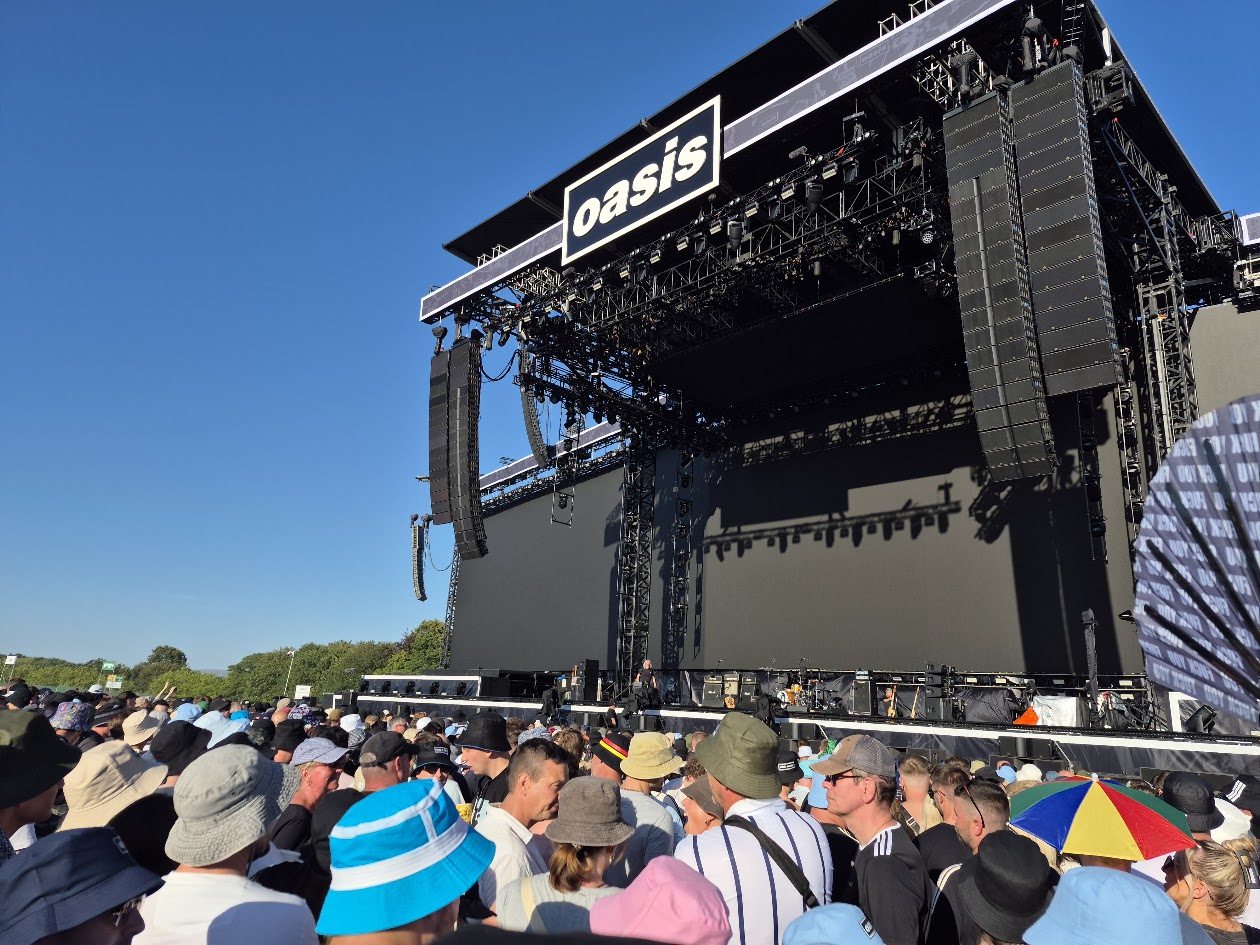
A seismic reunion after a 16-year hiatus, Oasis’ triumphant return was much more than just a trip down memory lane.
Growing up, I considered myself rather spoiled with the amount of music I had at my fingertips long before the days of streaming platforms and YouTube.
Thanks to my uncle’s career-turned-hobby as a DJ, my childhood computer was loaded up with hundreds of songs, primarily consisting of popular singles released in the United States between the mid 1960’s and early 2000’s.
I personally used this vast library to help develop my own taste in music, much of which came with the exploration of alternative rock from the 1990’s. Discovering Green Day, Third Eye Blind, Nirvana and the Red Hot Chili Peppers serve as core memories that helped me form both my love for music overall as well as for the era and genre.
In my perusing of the library, I stumbled upon Wonderwall by Oasis – a song I was already familiar with on surface level due to reading about its unprecedented global success, particularly in the U.K.
While I fell in love with Wonderwall and Champagne Supernova, the only other Oasis song found in that library, it was clear that my perception of Oasis wasn’t much different than many Americans – they were simply one of many popular rock bands in an era where alternative rock was as mainstream as it will ever get.
Yet elsewhere in the world, Oasis was the biggest band on the planet, dominating the charts and tabloid headlines throughout the 1990’s as they became the global face of the Britpop genre and cultural movement. Their background, of Irish working-class origin in Manchester, was seen as a pivotal part in the band’s appeal – while their London-based Britpop rival Blur may have felt more angled towards an urban audience, Oasis became the soundtrack of a forgotten rural youth.
This all deeply fascinated me as I truly fell in love with the band earlier this decade after years of being a passive fan who always spoke highly of their music without knowing too much about it. As my wife and I began collecting records and we discovered more of their music, two casual fans of the band became greatly enamored by the lore of the Gallagher brothers’ feud, their incredible global popularity and their brash arrogance that was always a huge part of their brand.
Seeing Oasis in concert always felt like a pipe dream, something my mind didn’t even give too much energy too knowing it was incredibly unlikely – my wife and I braved historic wildfire smoke in Chicago in 2023 to see Noel Gallagher’s High Flying Birds, believing that was the closest we would ever get to seeing Oasis live.
Every Oasis fan across the globe remembers where they were when they saw a post teasing to a possible reunion, with the seemingly impossible confirmation of such news coming two days later with the announcement of UK/Ireland dates that was later revealed to be a world tour.
Living in Chicago at the time, I was content to try to just see their one show at Soldier Field, enamored by the prospects of seeing them in the U.K. but feeling overwhelmed at what it would take to make it happen. My college roommate, a fellow Oasis fan who had previously studied abroad in the U.K., opted to brave the heavily maligned Ticketmaster wait room in the middle of the night, successfully securing tickets to Oasis’ first show back in Manchester on July 11.
The first show in Manchester was just their third of the tour following two opening shows in Cardiff, with the concert serving as the first of five shows in their return to their home city after a 16-year wait.
The energy felt in Manchester upon arrival was palpable – as a lifelong sports fan who has attended a wide range of important games, the atmosphere and camaraderie could only be compared to that outside Wrigley Field for Game 5 of the 2016 World Series in my personal experience.
The Manchester concerts also provided an atmosphere unique to most locations on the tour – instead of the stadium setting most locations had for the tour, Manchester’s massive Heaton Park hosted Oasis for this tour, due to renovations taking place at Etihad Stadium.
Heaton Park hosted approximately 370,000 fans across Oasis’ five shows, and it felt every bit as massive as the number suggests. We happened to be lucky enough to win the lottery for front standing room for the show, giving us an impeccable view of Oasis’ return to Manchester in a sea of tens of thousands of people.
Adding to the jubilant atmosphere in Manchester was the lineup of the opening acts – while I’m not here to pick a bone with Cage the Elephant or Ball Park Music, the tour’s opening acts in the U.S./Canada and Australia, the U.K. leg of the tour provided a mini Britpop music fest for those attending.
Make no mistake – the show was absolutely about Oasis. But having Britpop stalwart Cast and Richard Ashcroft of The Verve lead into the show made it crystal clear just how special this concert and experience was to those that had the city and culture of Manchester flowing through their veins.
The energy quickly escalated as Cast opened their set with their 1995 hit Alright, merely giving previews of what eventually turned into a full singalong throughout the entire crowd by the back half of Richard Ashcroft’s set.
Ashcroft closed his set with Bitter Sweet Symphony, a global hit that has long been one of my favorite songs by any artist – hearing the unmistakable riff of the track ripple through thousands of people who were merely moments away from something they only could have imagined in their dreams (myself included) was truly unforgettable.
Yet it somehow pales in comparison to Oasis’ entrance that evening – a Stanley Cup Playoff game in Nashville and Miguel Montero’s Game 1 grand slam in the 2016 NLCS were simply no match for the total eruption of the crowd when Noel and Liam took the stage together joining hands. While I was taken back by just how loud the crowd was, it made it so clear what this moment and reunion meant to so many people.
Oasis played the same 23-song setlist at all 41 shows of the tour, a setlist that honestly couldn’t have been drawn up any better. Heavily relying on their legendary hits from Definitely Maybe and (What’s The Story) Morning Glory, the band mixed in plenty of favorites from their B-side compilation The Masterplan as well, taking center-stage during a three-song acoustic set from Noel during the middle of the show.
A big part of Oasis’ appeal in the 1990’s certainly had to do with their attitude, arrogance, and above all else, loudness, both in and out of their music. Their first two albums came at the height of the loudness war, with many of their biggest songs sounding maximalist and heavy when listening to a recording.
Somehow, a pair of brothers in their 50s matched this energy they pioneered on cocaine and cigarette-fueled binges of the ’90s, making their biggest hits sound every bit as massive and earthshattering as they did upon release.
The first five songs of the setlist made this obvious, choosing some of their loudest and heaviest songs to ignite an already raucous crowd. While Hello made a perfect opener, 75,000 or so fans exploded during the playing of Acquiesce, a song interpreted by many to be about the brother’s uneasy but necessary truce beneath a highly publicized lifelong feud.
Each one of the 23 songs played during the concert was a full-blown singalong, with fans of all ages and backgrounds from Manchester and across the globe relishing in the tunes that serve as the soundtrack to so many people’s lives.
As an American, witnessing this up close made it make a bit more sense why Oasis just wasn’t what they were across the rest of the globe in the U.S., where they lagged behind bands that made more introspective, vulnerable and sometimes depressing music.
While Britpop as a whole was seen as a response to the gloomy grunge and indie rock that was popular stateside, Oasis’ music in particular was at the focal point of that approach and mindset.
I’m not going to bullshit anyone here – Oasis’ music isn’t the most complex or complicated that’s ever been written, and I’d be among the first to say that their primary Britpop rival in Blur has a more complete, musically impressive discography.
Yet what made Oasis’ music so great in the 1990’s is the main thing that makes it age even better when revisiting on this year’s tour – it’s optimistic and bright when our music is oftentimes not. The songs are simultaneously vulnerable and confident, flexible to interpretation and incredibly communal.
Many times, fans of music dig into what a particular song is about and what experiences helped shape the perspective felt in the lyrics and music – yet Noel Gallagher’s songwriting at several points proves that ambiguity is perhaps the most powerful tool.
Take it from the man himself, who couldn’t tell you what his own songs mean. Oasis closed the concert with Champagne Supernova, a psychedelic and emotional ’90s anthem widely considered to be the band’s magnum opus. As for what it’s about? Here’s what Noel said in a 2009 interview –
“This writer, he was going on about the lyrics to ‘Champagne Supernova’, and he actually said to me, ‘You know, the one thing that’s stopping it being a classic is the ridiculous lyrics.’ And I went, ‘What do you mean by that?’ And he said, ‘Well, Slowly walking down the hall, faster than a cannonball — what’s that mean?’ And I went, ‘I don’t know. But are you telling me, when you’ve got 60,000 people singing it, they don’t know what it means? It means something different to every one of them.’”
Gallagher shared the same sentiment with another one of the band’s hallmark tunes in Don’t Look Back in Anger, a performance that served as a highlight of the evening given the song’s significance in Manchester in the wake of the 2017 Manchester Arena bombing.
Those two tracks perhaps perfectly encapsulate what made this tour and Oasis as a band so special – the lyrics have seemingly endless interpretations, with two songs that can appropriately be played at a wedding or a funeral, after a first date or following a breakup, after being fired or after getting a new job.
Instead of music to help further drown one in their sorrows, Oasis’ biggest hits have long served as a soundtrack of optimism – one that has carried its longterm fans through decades of ups and downs in life, being a constant escape and refuge even as the brothers themselves stayed as far away from each other as possible for years.
Hearing these songs played in front of thousands of people who have been listening to them for 30 years put a spotlight on the communal atmosphere created at seemingly every Oasis show on this tour – everyone in the crowd has an experience or memory these songs are tied to, covering every emotion imaginable.
In an era of pervasive divisiveness and constant isolation, the Oasis Live 25 tour brought a desperately needed dose of positive energy to the world of music and pop culture as a whole.
There wasn’t much banter between the brothers, and there didn’t need to be – that evening in Manchester and 40 others just like it over the past few months was a celebration many were in dire need of. One where jubilation, nostalgia and community triumphed over uneasiness, anxiety and despair.
Some might say, we will find a brighter day.
Leave a Reply