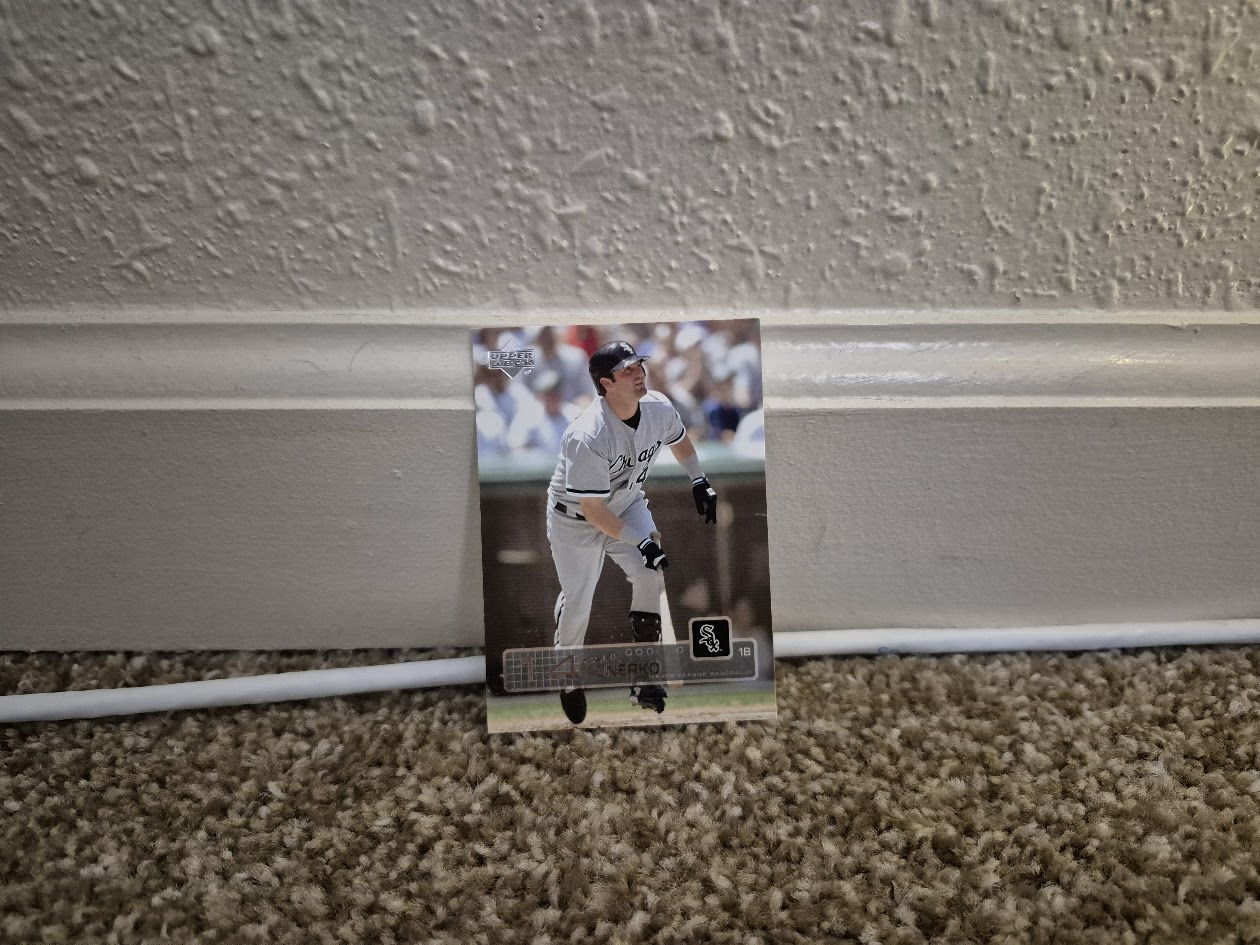
Despite nearing the end of his illustrious MLB career, Paul Konerko compiled perhaps his finest season towards the end of his playing days in 2010.
Growing up in the 2000’s in a Chicago suburb that favored the White Sox over the Cubs, Paul Konerko was an inescapable, ubiquitous name among the area’s most ardent baseball fans, and with good reason.
Originally a Los Angeles Dodgers farmhand, Konerko spent parts of two seasons with the Dodgers before playing 26 games with the Cincinnati Reds in the second half of the 1998 season following a deal at the trade deadline.
Following the season, Konerko was dealt for the final time of his career in a one-for-one swap that sent Mike Cameron back to Cincinnati while Konerko was moved to Chicago’s South Side. Instantly becoming an everyday player in 1999, Konerko spent the next 16 seasons with the White Sox and became one of the franchise’s most recognizable players.
Identifying the peak of Konerko’s career isn’t very difficult – the 99-win White Sox cruised through the 2005 postseason with an 11-1 record, with Konerko providing one of the signature moments of the World Series championship run. In Game 2 of the series, Konerko blasted a go-ahead grand slam on a wet, cold night in Chicago in a moment that that is immortalized by White Sox fans.
While Konerko hit 40 home runs and finished sixth in American League MVP voting in 2005, the finest season of his career arguably came several seasons later for a solid White Sox team that didn’t quite have the juice to make it into October.
For his age-34 season in 2010, Konerko was an absolute monster. The veteran slugger hit 30 doubles, 39 home runs and 171 total hits to go with 111 RBI and a .312/.393/.584/.977 offensive line, giving Konerko a stellar 160 OPS+.
The magnificent offensive outburst led to fourth of six All-Star appearances for Konerko, along with a career-best fifth-place finish in that year’s MVP voting. Konerko finished the season with 4.7 wins above replacement, another career-high mark in a category where poor defensive output consistently weighed him down throughout his career.
Had Konerko been a better defender in 2010, he easily could have made an argument to be the winner of the award, with an even average defensive performance likely strengthening Konerko’s case. However, the veteran coupled the finest offensive season of his career with his worst defensive season, posting a -2.2 defensive WAR that was only matched in one other season from Konerko.
Despite the poor defense, the White Sox clearly benefitted from Konerko’s slugging throughout the season as they finished with an 88-74 record, a nine-game improvement from 2009 but still six games behind the division-champion Minnesota Twins, leaving the ChiSox out of the postseason.
Though an offensive stalwart across the board during the 2010 season, Konerko was particularly lethal in certain circumstances. The 34-year-old managed a potent 1.102 OPS against left-handed pitchers while hitting at a .342 clip with a 1.137 OPS when playing at what was then-U.S. Cellular Field.
While the White Sox did fall six games short of the playoffs, Konerko’s second half of the season certainly absolved him of any culpability for missing out on October. The slugger was particularly strong in August, which saw Konerko slash .382/.473/.609/1.082 with seven home runs, four doubles and a season-high 19 walks.
Additionally, while Konerko’s defense at first base was certainly subpar at best, there seemed to be real offensive benefit to having Konerko play the field. While still posting an excellent .920 OPS and .286 batting average in 23 games as a designated hitter, Konerko hit 34 of his 39 home runs as a first baseman while managing a .989 OPS when playing the position.
As is the case with essentially all MVP candidates, Konerko posed particular danger with men on or with runners in scoring position. Konerko was 51-for-158 with RISP for the season with nine doubles and nine home runs, good for a .323 batting average and .962 OPS.
With any men on, Konerko posted a 1.015 OPS with 16 doubles, 16 home runs and 41 walks to 49 strikeouts, proving to be a tougher out than usual with the pressure applied to the opposing pitcher.
Konerko’s value was also made apparent during tie games, which saw the White Sox icon slash .353/.429/.608/1.037 over the course of 177 plate appearances. In a strange case of reverse splits, however, Konerko seemed to be at his best the first time he was seeing a pitcher during a game.
While still hitting .297/.414/.586 against a starter the third time through the order, Konerko hit .359 with a 1.018 OPS against starters facing the lineup the first time through, accounting for eight of his 25 home runs off of starting pitchers for the season.
The White Sox finishing six games behind the Twins for the division has a pretty obvious culprit – the South Siders were an abysmal 5-13 against their archrivals for the season. Still, one would be quite hard-pressed to put those losses on Konerko’s shoulders.
Playing all 18 games against the Twins, Konerko posted a .391/.468/.681/1.150 offensive slash line against Minnesota, with five home runs, three doubles and 27 total hits. Though also stellar against the Detroit Tigers in 2010, Konerko saved his best divisional performances for games against the Twins.
In perhaps his highlight showing of the season, Konerko went 5-for-5 against the Twins on Aug. 19 at Target Field, slugging a double and a home run while driving in four runs in what was an emphatic 11-0 victory.
While the 2010 season was Konerko’s finest offensively by several metrics, it still wasn’t the last hurrah in his career prior to his retirement following the 2014 season.
Konerko was named an All-Star in each of the following two seasons, finishing 13th in AL MVP voting in 2011 after hitting .300 with 31 home runs and a 141 OPS+. Though still a .298 hitter with a 130 OPS+ for the 2012 White Sox that fell just short of the postseason, Paulie’s numbers saw a more definitive downturn following that season.
Konerko hit 16 doubles and 12 home runs in 2013 alongside a .669 OPS and 82 OPS+ for a team that ultimately lost 99 games. The veteran’s role transitioned into more of a de facto player-coach position for the 2014 season, in which Konerko hit eight doubles and five home runs over the course of 224 plate appearances in 81 games.
Although poor defense that persisted throughout Konerko’s career took a major hit to his career WAR and therefore his Hall of Fame candidacy, there’s no question that the White Sox legend still had an incredible career that is worth remembering and celebrating.
Konerko hit several offensive milestones that are shared by a plethora of Hall of Famers, eclipsing 4,000 total bases while finishing his career with 439 home runs, 410 doubles, 2,340 hits and 921 walks. While some comparatively lackluster seasons were sprinkled in here and there through Konerko’s career, he retired as a career .279 hitter with an .841 OPS and 118 OPS+, reflecting the slugger’s status as a consistently above-average hitter in an era primarily dominated by offense.
Since Konerko’s 2010 season, White Sox fans haven’t been treated to a ton of elite offense from a star player. Outside of José Abreu’s MVP campaign in the pandemic-shortened 2020 season, fans have seen just one other top-five MVP finish in the years since, that being Abreu’s fourth-place showing in his 2014 rookie campaign.
Though baseball fans outside of the Chicago area often overlook Paul Konerko and his accomplishments, his 2010 season may have been the campaign that best shaped his legacy to the Chicago faithful. Across the course of three decades, Konerko had been a productive and instrumental part of baseball on the South Side.
He may not be a Hall of Famer, but anybody telling the story of Major League Baseball through the first decade of the new millennium would be omitting a lot by not acknowledging Paul Konerko’s fantastic career.
Leave a Reply