As a years-long battle for a new stadium continues, the franchise’s preferred option of a stadium across state lines is not one that would go over well for most of the team’s fans.
Being a lifelong sports fan, it’s always interesting to look back at some of my earliest sports memories as a kid and think about their significance today, with more time going by each year to contextualize the rarities I saw and remembered from the early 2000’s.
While I grew up primarily a baseball and hockey fan, one memory that remains conspicuous nearly a quarter-century later is the year-long renovation of Soldier Field in 2002, necessitating a full season of Bears football at the very underwhelming Memorial Stadium in Champaign, Ill.
To this day, it still blows my mind that an NFL team played a full season in one of the most boring college towns in America at a forgettable Big Ten stadium, but the result of that year-long renovation is what has led to a long battle between the Bears and multiple state and local governments as the franchise yearns for a new fixed-roof facility.
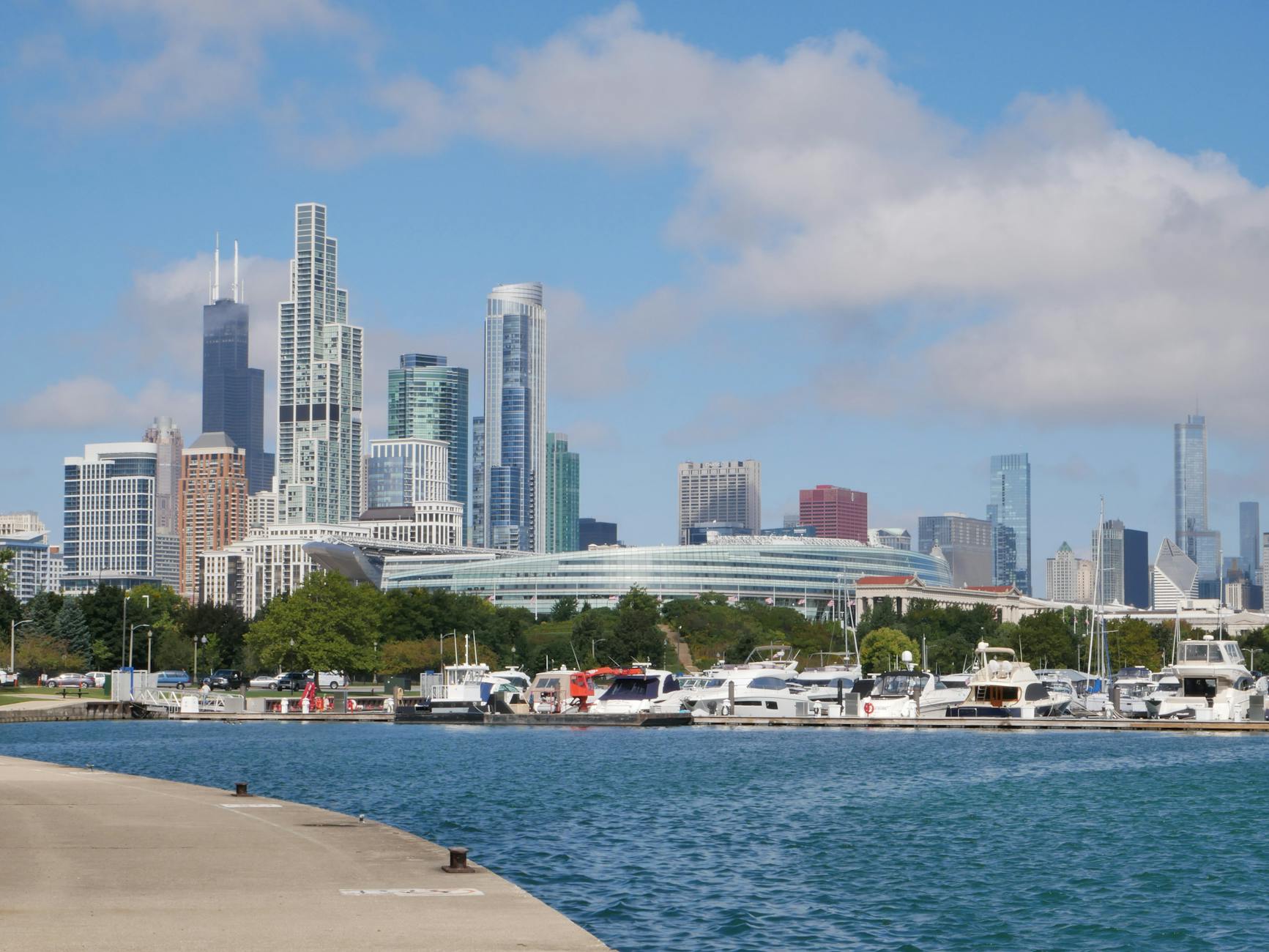
Built as a track stadium with a single bowl of seating and majestic views of the Chicago skyline, Soldier Field was renovated to reopen in 2003 as a reimagined facility – retaining the iconic facade around the stadium while adding an upper deck that makes it look like a spaceship crashed into a track stadium from those passing by on DuSable Lake Shore Drive.
In the 22+ years since the stadium’s reopening, Soldier Field has long been known as one of the worst stadiums in the NFL, heavily criticized for its awkward seating layout, poor field conditions and relatively low capacity for an NFL stadium.
Under the ownership of Kevin Warren, the Bears have made it no secret that they want a new, fixed-roof stadium that has the ability to both host a Super Bowl and year-round events – neither of which the Chicago Park District-owned Soldier Field is fit for.
Warren’s Bears have explored numerous options, initially focusing on a mixed-use entertainment district in northwest suburban Arlington Heights before pivoting back and forth between that and a new stadium on Chicago’s lakefront.
Without a lucrative private influx of money and facing headwinds from a state government understandably reluctant to hand the Bears a blank check, the franchise has now turned across state lines. This week, the Indiana House unanimously passed legislation to establish a stadium authority for a potential new home for the Bears, with a plot of land on Wolf Lake being floated as a site for the park.
Located alongside Chicago’s Southeast Side and the Illinois-Indiana border, the stadium would be located in Hammond, Indiana – a location that is technically closer to Chicago than Arlington Heights is, as my former WCIU colleague Brandon Pope pointed out.
For fans already in Northwest Indiana and on Chicago’s South Side and south suburbs, Hammond either is or may be easier to access than Soldier Field was – but this ultimately only accounts for a fraction of the team’s fans across the sprawling metropolis.
While Arlington Heights’ location is certainly nowhere near downtown Chicago, access is made relatively easier for many fans thanks to a Metra station located along the Union Pacific Northwest Line, a highly trafficked route that traverses through Chicago’s densely populated Northwest Side and suburbs, including Des Plaines, Park Ridge and Mount Prospect.
With the route starting at the Ogilvie Transportation Center in the Loop, fans in pretty much all of Chicago and throughout the North and Northwest suburbs have a relatively clear route to a potential stadium in Arlington Heights – which doesn’t exactly translate for fans trying to get to Hammond.
For one, public transit into Indiana is already limited in the Chicago area, and rather inconvenient for a Wolf Lake site without an added transit station. With Metra not traveling into Indiana at all, the lone public transit option for fans in Chicago is the South Shore Line, with trains running southeast beginning at downtown’s Millennium Station.
While fans on the Illinois side of the border could feasibly take their own Metra lines and transfer to the Union Pacific Northwest line downtown if they were taking public transit, a trip to Indiana would require a drive or train downtown prior to a lengthy transfer – with Millennium Station located well east of both Union Station and the Ogilvie Transportation Center.
Even for those who do live along the South Shore Line, the Wolf Lake site remains a nine-minute drive from the Hammond Gateway station, currently the closest station to the proposed stadium site on the South Shore Line.
This level of complication would certainly make some fans feel like they should just drive to the game, which comes with plenty of its own complications. While most, but not all, fans can make their way downtown via car on a toll-free ride, that possibility would be eradicated with a trip over state lines, with the nearby Chicago Skyway costing a hefty $8.10 to cross.
Those looking to cross the border on the more inexpensive but still not free I-80/I-94 route would still have to take a 20-minute drive without traffic to reach Wolf Lake – and one can only assume traffic would be the worst its ever been in the region on an NFL gameday.
Beyond the logistical difficulties that most of the team’s fans would face in getting to games, the franchise is clearly not considering the team’s close cultural ties to Illinois, the 55.2 miles between Wolf Lake and the Bears’ facility at Halas Hall in Lake Forest and the general unwillingness the league has shown to host Super Bowls in cold weather cities, even with a fixed roof.
Though I currently live in Northern California and plan to stay here indefinitely, I’m a Chicago-area native who spent all of my life in the region sans my years in college, which included five years living in city proper. I’m also not at all a Bears fan and don’t view myself to have that much of a dog in the fight when it comes to the NFL.
With that said, there is no denying the unique cultural role and significance the Bears have in the Chicago area.
I wish I could say it was the same for other teams in the city, especially the Cubs, whose championship win in 2016 led to one of the largest gatherings in human history. Yet I and every other Chicago-area native would be lying if we said that Chicago was anything but a Bears town.
Folks who typically aren’t sports fans lock in every Sunday for a team that has been mostly mediocre throughout the course of my life. While baseball in Chicago is always set with the backdrop of the crosstown Cubs-White Sox rivalry, a good Bears team creates pure unity and camaraderie, stretching from dive bars in Gage Park to restaurants in Aurora and living rooms in Joliet.
Despite being born over 10 years after the Bears won the Super Bowl with a team widely cited as the greatest defensive team in league history, you couldn’t go a single football season without hearing about the ’85 Bears in the Chicago area – a team achievement that was and continues to be so deeply instilled into the future diehard fans of Chicago’s flagship team.
If all you ever see in life is dollar signs, then a move to Northwest Indiana makes perfect sense – the team would be able to exploit taxpayers on an investment the public will never see a return on, while getting a fixed-roof facility that could host year-round concerts and maybe a Super Bowl one day too.
But at what cost?
This isn’t to say that Chicago sports fans that are from and live in Northwest Indiana are illegitimate or less than by any means, but it is absolutely worth acknowledging that the two areas are not at all the same culturally or historically – and the Bears would be giving up more than just an outdated stadium with a move over state lines.
The tricky thing is, I’m not writing all of this because I have a grand idea or answer – this is simply a brutal hole the Bears dug for themselves by not simply pursuing a new stadium in the early 2000’s, when there likely would have been more options both in and out of Chicago in a political environment that would have been more friendly towards teams looking for a government handout.
With no real progress on a stadium along both the lakefront and in Arlington Heights, the Bears appear to be committed towards a move that is widely unpopular with most of their fanbase – yet the alternative of staying in Soldier Field is viewed as wholly untenable for Warren’s Bears.
The team could of course try to explore more locations in the suburbs, or even look to build onto their facility in Lake Forest to keep the headquarters and home stadium in the same place – a location that would at least provide easy public transit and highway access for fans across the region.
Yet without a large influx of private funds to convince a local government on the Illinois side of the border that it’s all worth it, the writing is on the wall that a new stadium in Northwest Indiana is viewed as the best opportunity for Warren to get the fixed-roof, Super Bowl capable stadium he has sought out for years.
The public funds and promise of the potential of top-dollar events that may never materialize clearly outweigh the logistical nightmare for both fans and players and the cultural hit the team would take from moving out of Illinois.
Leave a Reply